
Most Norfolk Island Pines sold in November are dead by February. Not because they are difficult to grow. Not because they need complicated care or expensive equipment. They die because they are sold as decorations, placed in warm centrally heated rooms with 20 percent humidity, watered inconsistently, then discarded when their branches go brown after the holidays. That is a waste of a plant that, grown correctly, becomes one of the most distinctive and long-lived indoor trees you can own.
A well-cared-for Norfolk Island Pine can reach 6 to 8 feet (1.8 to 2.4 meters) indoors over a decade of careful growing, and the same plant decorated as a living Christmas tree in December becomes a striking architectural specimen for the other eleven months of the year. This guide covers everything that determines whether your Norfolk Island Pine thrives long-term or becomes another holiday casualty by Valentine’s Day.
| Aspect | Details |
|---|---|
| Botanical Name | Araucaria heterophylla |
| Common Names | Norfolk Island Pine, Norfolk Pine, Star Pine, Triangle Tree |
| Plant Family | Araucariaceae (not a true pine — a conifer from a separate ancient family) |
| Native Region | Norfolk Island (South Pacific, between New Zealand and New Caledonia) |
| Light | Bright indirect to some direct morning sun; 6+ hours daily |
| Water | When top 1-2 inches (2.5-5 cm) dry; keep evenly moist, never soggy |
| Humidity | 50-70% — the most critical requirement of all |
| Temperature | 60-72 degrees F (15-22 degrees C) — cooler than most indoor plants prefer |
| Soil | Well-draining, slightly acidic mix |
| Mature Size Indoors | 6-8 feet (1.8-2.4 m) over 10+ years |
| Mature Size Outdoors | Up to 200 feet (60 m) in native habitat |
| Growth Rate | Slow — 3 to 6 inches (7.5 to 15 cm) per year indoors |
| Toxicity | Mildly toxic to cats and dogs (ASPCA) |
| Difficulty Level | Intermediate (humidity management is the challenge) |
| USDA Zones | 10-11 outdoors; houseplant everywhere |
| Lifespan Indoors | Decades with correct care |
What a Norfolk Island Pine Actually Is (And Why It Matters)
Before getting into care, one clarification that changes how most people approach growing a Norfolk Island Pine: it is not a true pine. Araucaria heterophylla belongs to the family Araucariaceae — an ancient group of conifers that was widespread during the age of dinosaurs and now exists in only a few isolated locations on Earth. The Norfolk Island Pine is native specifically to Norfolk Island in the South Pacific, where it grows to extraordinary heights in humid, mild, oceanic conditions.
That natural environment tells you everything you need to know about what this plant needs indoors. It comes from a place with high humidity, mild temperatures, bright light, and regular rainfall that drains through rocky volcanic soil. It is not a cold-weather plant. It is not a drought-tolerant plant. It is a subtropical tree growing in conditions that are fundamentally different from a centrally heated US home in December — which is exactly why most of them do not survive the holiday season.
Norfolk Island Pine Care: Humidity Is Everything
No other factor in Norfolk Island Pine care matters as much as humidity. Not light. Not watering. Not fertilizing. Humidity. Araucaria heterophylla evolved in maritime subtropical conditions with year-round relative humidity of 70 to 85 percent. When it is brought into a US home where central heating drops indoor humidity to 20 to 35 percent during winter, the plant begins dropping branch tips and developing brown, crispy needles within weeks not because of anything you did wrong with watering or placement, but because the air itself is wrong.

The brown tips and branch drop that most people associate with “not enough water” in a Norfolk Island Pine are almost always a humidity crisis, not a hydration crisis. Adding more water to a low-humidity Norfolk Island Pine does not fix the problem and often creates root rot alongside the dryness damage.
What adequate humidity actually looks like for Norfolk Island Pine:
- 50% relative humidity minimum during the growing season
- 60-70% preferred through winter when heating runs consistently
- Never below 40% for extended periods
How to provide it: A dedicated humidifier is the most reliable solution, and for a plant this sensitive to dry air, it is not optional it is the foundation of successful Norfolk Island Pine care. Our guide on best humidifier for plants covers the most effective options for tropical and subtropical plants at different room sizes and price points. Supplemental methods like pebble trays (fill a wide tray with pebbles, add water below the pebble level, set the pot on top) and grouping the Norfolk Island Pine with other moisture-releasing plants help but do not replace a humidifier in dry climates or during heating season. Misting the foliage directly provides temporary surface moisture but evaporates within minutes and does not raise ambient humidity meaningfully for a plant with this level of need.
Light Requirements: More Than People Expect
Norfolk Island Pine is frequently labeled as a low-light plant in retail settings, which is misleading and directly responsible for many care failures. It tolerates lower light better than some plants, but Norfolk Island Pine care done correctly requires bright indirect light for 6 or more hours daily. In lower light, growth stalls, the lower branches thin out progressively, and the plant loses the dense, symmetrical layered structure that makes it so visually distinctive.
The ideal position is near a south or east-facing window where the plant receives strong indirect light and possibly a couple of hours of gentle direct morning sun. Avoid harsh afternoon direct sun in summer, which can bleach the needles. A north-facing window in most US homes does not provide enough light intensity for a Norfolk Island Pine to maintain its form over time.
Rotate the plant a quarter turn every two weeks. Norfolk Island Pines lean noticeably toward the light source, and without rotation, one side of the plant becomes significantly fuller than the other within a growing season particularly noticeable on a plant you intend to display as a Christmas tree.
If your available windows do not provide 6 hours of bright indirect light, a quality grow light positioned above the plant for 12 to 14 hours daily is a practical solution, particularly through the winter months when natural light is shortest. Our guide on best grow lights for indoor plants reviews the most effective options for tall, light-hungry plants like Norfolk Island Pine.
Norfolk Island Pine Care: Watering Correctly
Norfolk Island Pine watering occupies a specific middle zone that is slightly different from most houseplants: the soil should stay evenly moist but never waterlogged, and it should never be allowed to dry out completely between waterings. This balance is different from the “let it dry out fully” approach that works for snake plants and pothos, and different from the “keep constantly wet” approach that suits peace lilies.
Check the soil every 5 to 7 days by pushing a finger 1 to 2 inches (2.5 to 5 cm) into the potting mix. When the top layer feels dry and the soil underneath still feels slightly cool and barely moist, water thoroughly until it drains from the drainage hole. Let it drain completely. Never leave the plant sitting in a saucer of standing water.
In winter, reduce watering frequency slightly not dramatically, because Norfolk Island Pine does not go fully dormant but extend the check interval from every 5 days to every 7 to 10 days and confirm the soil genuinely needs water before adding any. Root rot from overwatering is the second most common cause of Norfolk Island Pine decline after low humidity. Our guide on overwatering vs underwatering covers the exact visual symptoms that distinguish each problem.
Water quality note: Norfolk Island Pine is moderately sensitive to fluoride and mineral salts found in tap water. If the leaf tips brown despite adequate humidity, try switching to filtered or distilled water. Alternatively, leave tap water to sit uncovered overnight before using, which dissipates some of the chlorine though not the fluoride.
Soil, Pot, and Repotting

Norfolk Island Pine grows slowly and does not need frequent repotting every 2 to 3 years in spring is the appropriate rhythm for most indoor specimens. The soil mix should drain well while retaining some moisture between waterings. A slightly acidic mix works best: standard potting mix amended with 20 percent perlite and a small amount of peat moss or coco coir provides the right balance of drainage, moisture retention, and mild acidity. For a full comparison of soil mixes and amendment ratios for different plant types, our guide on best soil for indoor plants covers every option available at US garden centers.
Always choose a pot with drainage holes. Terra cotta pots suit Norfolk Island Pine well because the porous walls help prevent overwatering and provide some airflow to the root zone. Avoid the common mistake of placing a decorative pot sleeve under the nursery pot without drainage the water that collects below creates exactly the waterlogged conditions this plant is susceptible to. Our guide on best planters for indoor plants covers material and sizing guidance for large, slow-growing indoor plants.
One important note specific to Norfolk Island Pine repotting: this plant dislikes root disturbance. When repotting, handle the root ball as gently as possible and disturb the roots minimally. Excessive root disturbance causes significant branch drop and can set the plant back by an entire growing season.
Temperature: Cooler Than Most Houseplants Prefer
Norfolk Island Pine is a subtropical plant from an island with mild temperatures year-round, and it performs best when indoor temperatures stay between 60 and 72 degrees F (15 and 22 degrees C). This is cooler than most tropical houseplants prefer, and it is one of the reasons Norfolk Island Pine actually benefits from some of the natural cooling of late fall and winter as long as drafts and cold floor-level temperatures are avoided.
Keep it away from:
- Heating vents that blow hot, dry air directly onto the foliage
- Cold drafts from exterior doors in winter
- Cold concrete floors (elevate the pot on a plant stand)
- Windows that frost or develop condensation in very cold climates
Temperatures above 85 degrees F (29 degrees C) for extended periods cause stress, particularly when combined with low humidity. A Norfolk Island Pine struggling in a hot, dry room in summer is experiencing the same double stress heat and dryness that kills holiday plants in heated winter rooms.
Fertilizing Your Norfolk Island Pine
Norfolk Island Pine is a slow grower with modest nutrient needs. Over-fertilizing pushes weak, distorted growth and causes mineral salt buildup that damages the root system over time. The correct approach: a balanced liquid fertilizer at half the label-recommended strength, applied monthly from April through August. Jack’s Classic All Purpose 20-20-20 or Miracle-Gro Indoor Plant Food both work reliably at half strength. Stop fertilizing completely from September through March the plant’s growth slows significantly and unused nutrients accumulate as mineral salts.
If you see white crusty deposits forming on the soil surface, flush the pot thoroughly with plain water at the sink for a full 2 minutes before applying any new fertilizer in spring.
Using Norfolk Island Pine as a Christmas Tree
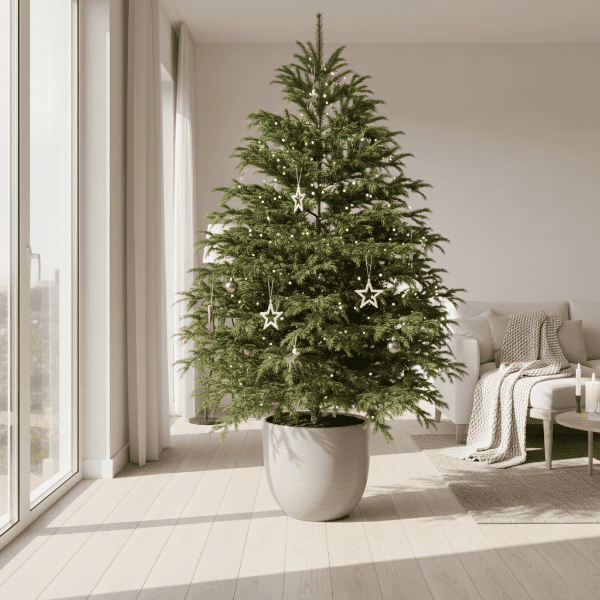
This is one of the most genuinely useful things a Norfolk Island Pine can do: serve as a living, growing Christmas tree that you decorate in December and continue caring for through the following year. Done correctly, it works beautifully. Done incorrectly, it accelerates exactly the conditions that kill the plant.
What works:
- Small, lightweight ornaments hung from the stronger lower branches
- LED string lights only traditional bulb lights generate heat that dries the foliage
- Paper or fabric decorative items that do not add weight
- A tree skirt that allows air circulation around the base
What to avoid:
- Heavy ornaments that bend or break branches (they do not regenerate)
- Traditional incandescent or halogen lights (heat + dry air = needle drop)
- Placing in a warm, low-humidity room specifically for the holidays
- Moving it to a poorly lit location because “it’s a Christmas tree now”
The critical mistake: Many people move their Norfolk Island Pine away from its bright window position to a central room location for better holiday display. This removes the light it needs while adding the dry heated air it cannot tolerate. The plant starts dropping needles within two weeks, and by January it looks like a winter damage victim rather than a thriving plant.
The correct approach: Keep it in its usual bright window position. Decorate it lightly with small, lightweight ornaments and LED lights. Move it only if the display position also provides 6 hours of bright light and adequate humidity. The plant that stays healthy through December is the one that decorates your home the following November as well.
Norfolk Island Pine: Seasonal Care Calendar
| Season | Key Task | Watering | Fertilizing | Watch For |
|---|---|---|---|---|
| Spring (Mar-May) | Move to brightest position; resume fertilizing | Every 5-7 days | Monthly at half strength | New growth from top — healthy sign |
| Summer (Jun-Aug) | Rotate 1/4 turn every 2 weeks; check humidity | Every 5-7 days | Monthly at half strength | Heat + low humidity stress if A/C too cold |
| Fall (Sep-Nov) | Begin humidifier routine; stop fertilizing | Every 7-10 days | None | Branch tip browning = humidity alert |
| Winter (Dec-Feb) | Decorate as Christmas tree with LED lights only | Every 7-10 days | None | Needle drop = humidity too low; check heater vents |
Common Problems and What They Mean
Brown needle tips spreading outward: The most common complaint with Norfolk Island Pine. Almost always low humidity combined with heating-system dry air. Increase humidity immediately this is the one problem that does not wait. Once branches die back significantly, they do not regenerate. Check our guide on plant leaves turning yellow for how to assess whether the browning has a nutrient or watering component alongside the humidity issue.
Dropping lower branches: Low light, overwatering, or root rot. A Norfolk Island Pine that has been sitting in dim conditions gradually drops its lower branches from the bottom upward as the plant concentrates resources toward the growing tip. The dropped branches do not grow back once lost, that tier of the plant’s structure is gone permanently. Check light levels first. If light is adequate, check the soil for waterlogging.
Yellowing foliage: Most commonly caused by overwatering, poor drainage, or root rot. Less commonly by severe nutrient deficiency after multiple years without fertilizing. Check the soil moisture and drainage before adding any fertilizer. Our guide on root rot treatment covers the full diagnosis and recovery process for a Norfolk Island Pine showing signs of root damage.
Leaning or tilting toward light: Normal growth behavior, not a problem. Rotate the pot a quarter turn every two weeks to maintain symmetrical growth. A Norfolk Island Pine that has leaned significantly for months will not straighten immediately it may take a full growing season of rotation to develop more symmetrical new growth.
No new growth: Expected in winter and during the early adjustment period after repotting or moving. If growth has been absent through an entire spring and summer, the cause is most likely insufficient light or root-bound conditions.
Is Norfolk Island Pine Safe for Pets?
According to the ASPCA, Norfolk Island Pine is mildly toxic to cats and dogs. The plant contains chemical compounds that can cause vomiting, depression, and anorexia if significant amounts are ingested. The toxicity level is classified as mild rather than severe, but a plant this size and with the visual interest that draws curious pets should be placed where cats and dogs cannot chew on the foliage regularly. If you need a large indoor plant that is completely safe around pets, our guide on indoor plants safe for cats covers confirmed non-toxic alternatives across different sizes and light requirements.
Mistakes That Kill Norfolk Island Pine
Treating it as a seasonal decoration. A Norfolk Island Pine is not a poinsettia. It is a long-lived subtropical tree that can become a decade-long fixture in your home. Buying it for December, neglecting its specific needs, and then composting it in January is the most common reason this plant does not get the chance to show what it can do.
Assuming low humidity is not the problem. When a Norfolk Island Pine declines, humidity is the correct first suspect in the vast majority of cases. Before adjusting watering, before changing soil, before moving it to a different room check and address the humidity.
Pruning the growing tip. Unlike most houseplants, cutting the top growing tip of a Norfolk Island Pine does not encourage branching. It permanently stops vertical growth and often causes the plant to develop an irregular, unbalanced form from that point forward. Never cut the central leader (the main upright growing tip) under any circumstances.
Buying too small a pot. Nursery Norfolk Island Pines are often sold in very small pots relative to their size. A plant this top-heavy in a small pot tips over easily and the root system is too restricted to support healthy growth. Repot into a container one size up with a weighted base if stability is an issue.
FAQ
Why does my Norfolk Island Pine have brown tips?
Brown tips on a Norfolk Island Pine almost always indicate low humidity. This is the most common problem with this plant, particularly during heating season when indoor air drops below 40 percent relative humidity. Running a humidifier near the plant and keeping it away from heating vents resolves new browning within 2 to 4 weeks, though already-browned needles will not recover their color.
Can Norfolk Island Pine survive indoors year-round?
Yes Norfolk Island Pine is a year-round indoor plant that can live for decades with correct care. It is not a seasonal plant despite being heavily marketed in that context. The keys to year-round success are bright indirect light for 6 or more hours daily, consistent humidity above 50 percent, and evenly moist but never waterlogged soil.
How fast does a Norfolk Island Pine grow indoors?
Slowly. Indoors, a Norfolk Island Pine grows 3 to 6 inches (7.5 to 15 cm) per year under good conditions. A plant purchased at 12 inches (30 cm) will reach approximately 2 to 3 feet (60 to 90 cm) over five years, and 6 to 8 feet (1.8 to 2.4 m) over a decade of careful growing. Outdoors in USDA zones 10 and 11, the same species can reach 200 feet (60 m) in its natural habitat.
Can I put a Norfolk Island Pine outside in summer?
Yes, in climates where summer temperatures do not exceed 85 degrees F (29 degrees C) consistently and night temperatures stay above 55 degrees F (12 degrees C). Outdoor placement in partial shade during summer significantly improves growth rate and plant health. Bring it back inside well before the first cool nights of fall do not wait for frost.
Why is my Norfolk Island Pine dropping branches?
Branch drop on a Norfolk Island Pine is most commonly caused by one of three things: insufficient light (the plant drops lower branches when it cannot support them), overwatering and root rot (root damage stops nutrient delivery to branches), or very low humidity over an extended period. Assess all three before taking action. Dropped branches on a Norfolk Island Pine do not grow back addressing the cause stops further loss but does not restore the plant’s original form.
How do I decorate a Norfolk Island Pine as a Christmas tree?
Use only small, lightweight ornaments and LED string lights (not traditional bulbs, which generate heat). Keep the plant in its usual bright window position rather than moving it to a central room display spot. LED lights do not generate meaningful heat and will not accelerate needle drop. Heavy ornaments can permanently bend or break branches, which do not regenerate, so err on the side of minimal decoration over maximum visual impact.
Is Norfolk Island Pine toxic to cats?
Yes mildly. The ASPCA classifies Norfolk Island Pine as toxic to cats and dogs, with ingestion potentially causing vomiting and depression. The toxicity is mild rather than severe, but the plant should be kept out of reach of pets that chew on foliage. See our guide on indoor plants safe for cats for confirmed pet-safe alternatives.
The Norfolk Island Pine is one of the few truly architectural indoor trees available to home growers at a beginner-accessible price point, and it earns a permanent place in any collection when given what it actually needs. Most of what it needs is humidity. The rest adequate light, careful watering, and restraint with fertilizer follows from understanding where this tree comes from and what its native environment looks like. Treat it as a living plant rather than a seasonal prop, and it will outlast every piece of furniture in the room where you choose to grow it.
Happy planting!