
I’ve had both plants growing side by side on the same shelf for years. Same light, same watering schedule, same spot in my living room. And every single time a visitor walks in, they point at one and ask: “Is that a pothos or a philodendron?” Honestly, it took me longer than I’d like to admit to tell them apart confidently. The pothos vs philodendron mix-up is probably the most common case of mistaken plant identity out there, and for good reason. These two plants look incredibly similar, both trail beautifully, both tolerate some neglect, and both thrive indoors. But they are not the same plant, and once you know what to look for, you’ll never confuse them again.
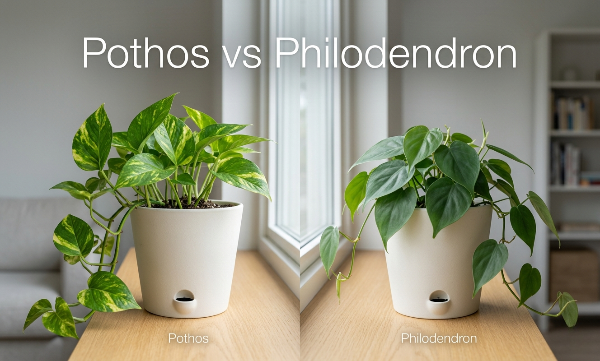
Pothos vs Philodendron: The Quick Comparison Table
Before we get into the details, here’s a full side-by-side look at how these two plants stack up:
| Feature | Pothos (Epipremnum aureum) | Heartleaf Philodendron (Philodendron hederaceum) |
|---|---|---|
| Leaf texture | Waxy, thick, slightly rigid | Softer, thinner, more velvety |
| Leaf shape | Asymmetrical with a pointed tip | More symmetrical, true heart shape |
| New leaf color | Emerges green right away | Unfurls bronze or reddish-brown |
| Leaf size | 2 to 4 inches indoors (up to 12 in./30 cm in wild) | 2 to 4 inches indoors (similar) |
| Stem feel | Thick, groove runs along the top | Thinner, rounder, more flexible |
| Petiole (leaf stalk) | Flattened on one side | Round, no grooves |
| Cataphyll present? | No | Yes – papery sheath that dries and falls off |
| Light tolerance | Extremely tolerant of low light | Prefers medium to bright indirect light |
| Watering | Very forgiving, bounces back from drought | Slightly more sensitive to overwatering |
| Growth rate | Fast | Fast |
| Toxicity | Toxic to cats, dogs, and humans (ASPCA) | Toxic to cats, dogs, and humans (ASPCA) |
| Difficulty | Beginner | Beginner |
| Price range | Very affordable ($5-$15) | Very affordable ($5-$15) |
How to Tell Them Apart: The Physical Differences That Actually Matter
This is the part that trips most people up, so let me walk you through exactly what I look for.
Leaf texture is the fastest giveaway. Pick up a leaf from each plant and feel it. A pothos leaf feels noticeably waxy and thick, almost like a stiff piece of leather. A heartleaf philodendron leaf feels much softer, almost like fabric. This single test works almost every time.
The leaf shape is your second clue. Pothos leaves are slightly asymmetrical, meaning one side of the base is a bit wider or higher than the other. They also tend to have a more pointed, elongated tip. Philodendron leaves are more evenly symmetrical and form a cleaner heart shape at the base, which is exactly where the name “heartleaf” comes from.
Here’s the one I rely on the most: watch how a new leaf unfurls. A pothos leaf emerges already green and somewhat mature-looking. A heartleaf philodendron leaf unfurls with a bronze or reddish-copper tint before gradually turning green over a few days. Once you’ve seen this happen, you’ll always remember it.
And if you want to be really sure, look for the cataphyll. Philodendrons produce a small papery sheath around each new leaf as it grows. This protective sleeve dries out and eventually falls off once the leaf matures. Pothos don’t have this. If you see a tiny dried papery husk near a new growth point, you’re looking at a philodendron.
Light: Which One Handles Low Light Better?
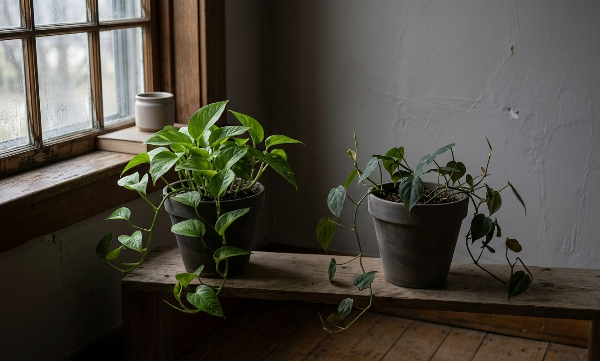
Both plants are known for tolerating lower light than most houseplants, but there’s a real difference between them once conditions get dim.
Pothos is one of the most light-tolerant houseplants in existence. I’ve kept golden pothos in a hallway with almost no natural light, and it kept growing, slowly, but it kept going. For philodendron, low light is survivable but not ideal. Growth slows more noticeably, and the leaves tend to get smaller and more spread apart on the stem (a condition called etiolation).
In my experience, both plants perform best in medium to bright indirect light. But if your space is genuinely dark and you can only have one, the pothos wins that contest.
Pro Tip: Variegated varieties of both plants, like golden pothos or Brasil philodendron, need more light than their all-green counterparts. The lighter the variegation, the more light the plant needs to produce energy through the green parts of the leaves.
Pothos vs Philodendron: Watering and Soil Needs
Watering schedules for these two plants are nearly identical. Both want you to water thoroughly and then wait until the top inch or two (2.5 to 5 cm) of soil is dry before watering again. Neither one likes sitting in soggy soil, and both can handle being slightly underwatered more gracefully than overwatered.
That said, heartleaf philodendron is a little pickier about consistently moist soil. If you go too long between waterings, it will communicate this to you with drooping leaves. Pothos will droop too, but it snaps back faster and forgives drought more readily.
For soil, both plants do well in a standard well-draining potting mix. I usually add a handful of perlite to whatever mix I’m using, roughly 20 to 30 percent of the total volume. This keeps the soil light and prevents compaction over time. A bag of Miracle-Gro Indoor Potting Mix with some perlite mixed in works perfectly for both.
Growth Habits: Trailing, Climbing, and Size
Both plants are natural climbers in the wild. Give either one a moss pole or a coir pole and they’ll grow larger leaves and longer, more dramatic trails. Without support, they trail downward beautifully, which is why they’re so popular in hanging baskets.
Pothos tends to trail with thicker, sturdier vines. The vines themselves have a subtle groove running along the top side of the stem, and the texture is firm. Philodendron vines are thinner and more flexible, which makes them a bit more willing to weave through other plants or wrap around a support.
Growth speed is similar between the two. Under good conditions with regular fertilizing, both can put out several inches of new growth per week during spring and summer. During the dry winter months when central heating reduces indoor humidity, both slow down noticeably.
Pro Tip: If you want bigger leaves on either plant, give them a moss pole to climb. The aerial roots they produce along their stems will grip the pole and trigger larger leaf production. This works especially well for philodendrons, which are more eager climbers in my experience.
Toxicity: Both Are a Problem for Pets
This section matters a lot if you have cats, dogs, or small children at home. Neither plant is safe to eat.
Both pothos and philodendron contain calcium oxalate crystals. According to the ASPCA, ingestion can cause drooling, vomiting, oral irritation, and difficulty swallowing in cats and dogs. The symptoms are similar for both plants, so this is one area where there’s no clear difference between the two.
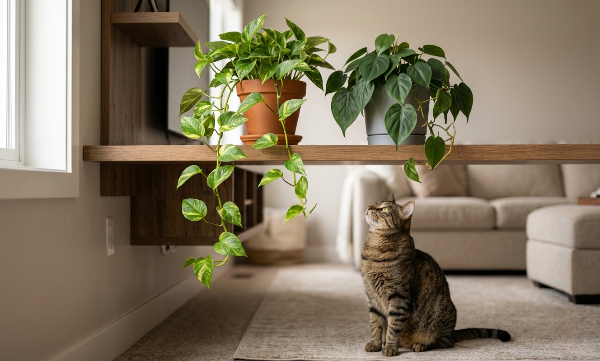
If you have curious pets, keep both plants out of reach on high shelves or in hanging baskets, or consider swapping for a pet-safe alternative entirely.
Read more: pet-safe indoor plants
Fertilizing Both Plants Through the Growing Season
From spring through early fall, I fertilize both plants monthly with a balanced liquid fertilizer. A diluted dose of Jack’s Classic All Purpose 20-20-20 or a half-strength Miracle-Gro Indoor Plant Food works well for both. More is not better here. Both plants are relatively light feeders compared to heavy growers like monsteras, and over-fertilizing causes more problems than it solves.
In winter, I stop fertilizing entirely. The plants aren’t actively growing, so feeding them during dormancy just causes salt buildup in the soil.
Where Most Beginners Go Wrong With These Plants
Whether you’re growing pothos, philodendron, or both, the mistakes tend to be the same. Here are the ones I see most often:
- Overwatering because the leaves drooped. Drooping can mean underwatering or overwatering. Always check the soil before adding water. If it’s still moist two inches down, wait a few more days.
- Putting them in a completely dark room. Both plants tolerate low light, but “low light” in plant terms is not zero light. A room with one small window is borderline. A windowless bathroom is too dark for long-term health in either plant.
- Treating variegated and solid green versions the same. As mentioned above, the more variegation on the leaf, the more light the plant needs. Keep your golden pothos or Brasil philodendron closer to a window than their all-green relatives.
- Not repotting when roots appear at the drainage holes. Both plants are fast growers and can get root-bound quickly. When roots circle the bottom of the pot or start peeking through drainage holes, it’s time to move up one pot size, usually 2 inches (5 cm) larger in diameter.
- Ignoring yellow leaves. The occasional yellow leaf is normal. A steady pattern of yellowing usually signals overwatering, poor drainage, or fertilizer deficiency. It’s the plant’s way of asking for attention, not a death sentence.
Pothos vs Philodendron: Which One Is Right for You?
Both plants are excellent choices for beginners and experienced growers alike. But here’s how I’d frame the choice based on your situation.
Choose pothos if you want the most forgiving plant possible, someone who will grow in lower light, bounce back from missed waterings, and ask almost nothing of you. Pothos is the plant for busy people, for dark apartments, and for anyone who has killed plants before and wants a genuinely tough starting point. It’s also the better pick if you love variegated foliage, since golden pothos, marble queen, neon pothos, and manjula all offer stunning leaf patterns.
Choose heartleaf philodendron if you want something with a slightly softer, more elegant look and you can provide consistent medium to bright indirect light. Philodendrons also come in incredible variety, from vining heartleafs to large-leafed uprights like the philodendron gloriosum or silver sword. If you get hooked on the heartleaf, the whole genus opens up to you.
Honestly, when people ask me which one I prefer in the pothos vs philodendron comparison, I always say: buy both. They’re cheap, they’re easy, and having them together actually makes it much easier to spot the differences I described above.
FAQs
What is the easiest way to tell pothos vs philodendron apart?
Feel the leaves. Pothos leaves are waxy and thick, while heartleaf philodendron leaves are soft and thinner. Also watch for new growth: philodendron leaves emerge with a bronze tint, while pothos leaves come out green. These two observations together are almost always enough to identify which plant you’re looking at.
Are pothos vs philodendron the same plant?
No, they are different plants from different genera. Pothos belong to the genus Epipremnum, while philodendrons are in the genus Philodendron. They belong to the same family (Araceae) and come from similar tropical environments, which is why they look and behave so similarly. But they are scientifically distinct.
Can you water pothos vs philodendron the same way?
Yes, their watering needs are nearly identical. Both prefer to dry out slightly between waterings. Let the top inch or two (2.5 to 5 cm) of soil dry out, then water thoroughly until it drains from the bottom. Neither tolerates sitting in soggy soil for long.
Is pothos easier to grow than philodendron?
Pothos has a slight edge when it comes to low-light tolerance and drought recovery. Both are beginner-friendly, but if you have very dim conditions or an unpredictable watering routine, pothos is the safer bet. Heartleaf philodendron isn’t difficult, it just appreciates slightly more consistent care.
Are both plants toxic to cats and dogs?
Yes. Both pothos and philodendron are toxic to cats, dogs, and humans according to the ASPCA. They contain calcium oxalate crystals, which cause oral irritation, drooling, and vomiting if ingested. Keep both plants out of reach of pets and young children.
How fast does each plant grow?
Both are fast growers under good conditions, capable of putting out several inches of new growth per week during the growing season. Pothos may edge out slightly in low-light conditions, but in bright indirect light, heartleaf philodendron can match or exceed it.
Do pothos and philodendron need the same fertilizer?
Yes. A balanced liquid fertilizer applied monthly during spring and summer works well for both. A half-strength dose of Miracle-Gro Indoor Plant Food or Jack’s Classic All Purpose 20-20-20 is a solid option. Both plants are light feeders, so less is more. Stop fertilizing through the winter months.
Which plant is better for a beginner – pothos or philodendron?
Both are excellent starting points. If I had to pick one for a complete beginner with unpredictable watering habits or a darker space, I’d say pothos. If you’re willing to be a little more attentive and have decent natural light, heartleaf philodendron is equally rewarding and perhaps even more beautiful as it matures.
Final Thoughts
The pothos vs philodendron question comes down to a few key differences: leaf texture, how new leaves emerge, and light tolerance. Neither plant is better than the other, they’re just different. Pothos is the champion of resilience. Heartleaf philodendron is the slightly more elegant sibling. Both are affordable, widely available at stores like Home Depot, Lowe’s, and Trader Joe’s, and adaptable enough to thrive in most homes. Get to know the differences, pick the one that fits your space and lifestyle, and you really can’t go wrong with either.