
I moved into my current apartment three years ago and immediately realized I had a problem. One north-facing window. Forty-something houseplants. The math did not work.
I had kept grow lights at arm’s length for years, convinced they were either too complicated, too expensive, or too ugly to live with. So I did what most plant people do first: I pushed my plants as close to the window as possible, rotated them obsessively, and watched them slowly stretch, pale, and decline anyway. A monstera that had been producing fenestrated leaves started pushing out small, uncut juvenile growth. My bird of paradise had not grown an inch in four months. The snake plants were fine, obviously, because snake plants are always fine, but everything that actually needed decent light was suffering quietly.
That winter I finally bought a grow light. Then another. Then I got slightly obsessive about testing different types across different plant setups. What I learned is that finding the best grow lights for indoor plants is not about buying the most powerful or the most expensive option. It is about matching the right type of light to your specific situation: the size of your space, the plants you are growing, what you are willing to spend, and honestly, whether you care what the thing looks like sitting in your living room.
This guide does exactly that. Five picks, each suited to a different grower situation, with no padded filler between them.
What Actually Matters When Choosing a Grow Light
Before getting into the picks, a quick primer on the numbers that actually matter so you can make sense of any product label.
- PAR (Photosynthetically Active Radiation) is the light spectrum plants actually use for photosynthesis, roughly 400-700 nanometers. This is what you want to look at, not just wattage. A 100W incandescent bulb produces plenty of wattage and almost no usable PAR for plants.
- PPFD (Photosynthetic Photon Flux Density) measures how much PAR reaches a given surface area at a specific distance. This is the closest thing to a real-world performance number. Low-light plants like pothos and ZZ plants need around 50-150 PPFD. Medium-light plants like monsteras and peace lilies want 150-400 PPFD. High-light plants like succulents, herbs, and most fruiting plants want 400-600 PPFD or higher.
- Full spectrum means the light covers the full photosynthetically active range, including both blue wavelengths (which drive vegetative growth and compact leaf structure) and red wavelengths (which support flowering and fruiting). Most modern LED grow lights marketed for houseplants are full spectrum. This is the right baseline for indoor plants.
- Color temperature in Kelvin tells you whether the light skews blue (higher Kelvin, 5000-6500K, good for foliage growth) or red (lower Kelvin, 2700-3000K, good for flowering). For general houseplant use, 4000-5000K is the sweet spot.
Duration matters as much as intensity. Most houseplants do well with 12-16 hours of grow light per day on a consistent timer. Running a light 8 hours and hoping it compensates for low intensity is a common setup mistake.
The 5 Best Grow Lights for Indoor Plants in 2026
Pick 1: GE Grow Light LED BR30 Bulb – Best for Beginners and Single Plants
Best for: Anyone new to grow lights, renters who cannot modify their space, growers with one to three plants that need a light boost.
If you have never used a grow light before and you are not ready to commit to a panel or strip setup, this is where to start. The GE BR30 Full Spectrum LED Grow Light screws into any standard lamp socket, E26 base, and produces a balanced full-spectrum output specifically designed for plant growth. It does not look like a grow light. It looks like a regular bulb with a slightly different color tone, which means you can run it in a floor lamp or desk lamp without it feeling like a science experiment in your living room.
The 9-watt version (which replaced the original 10-watt) runs around $15 at Home Depot and Lowe’s. That is the lowest barrier to entry in this entire category. I used one over a fiddle leaf fig that was dropping leaves from low light stress, positioned in a standard arc floor lamp placed 18 inches (45 cm) above the canopy and run 14 hours a day on a timer. New leaves emerged within six weeks and held their size.
The limitation is coverage area. At 18-24 inches (45-60 cm) distance, this bulb covers one medium plant effectively. For a shelf of six plants, you would need multiple lamps or a different setup entirely. The PPFD output at typical lamp distance is modest, which makes it excellent for low-to-medium light plants but insufficient for succulents or herbs that need higher intensity.
Price range: $13-$18 per bulb Where to buy: Home Depot, Lowe’s, Amazon Timer needed: Yes. Use a basic outlet timer, around $10, to run 12-14 hours consistently.
Pro tip: Run the GE BR30 in a swing-arm floor lamp rather than a table lamp. The adjustable arm lets you position it exactly above the canopy at the right distance without rearranging furniture every time a plant grows.
Pick 2: Barrina T5 LED Grow Light Strips – Best for Plant Shelves
Best for: IKEA shelf setups, dedicated plant shelves, seedling trays, anyone growing multiple small plants under one fixture.
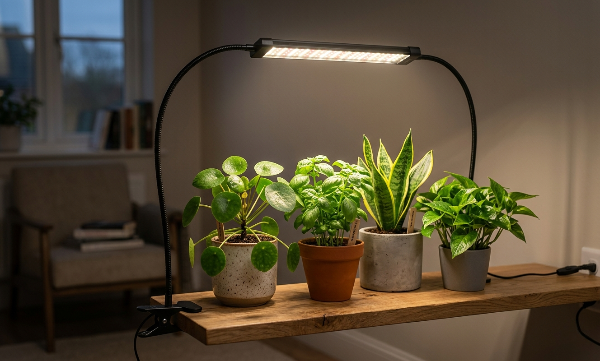
The Barrina T5 grow light strips are the workhorse pick for anyone building a dedicated plant shelf. They come in packs of four or eight, each strip around 2 feet (60 cm) long, and they daisy-chain together so one power cord runs multiple strips from a single outlet. They mount under shelves with included hardware, draw low wattage, run cool enough that you never worry about heat damage, and produce a good full-spectrum output in the 6000K range.
This is genuinely one of the best grow lights for indoor plants when your goal is maximizing a vertical growing setup. A standard 4-strip kit covering a 2×4 foot (60×120 cm) shelf runs around $35-$40 on Amazon. For that price you are covering an entire shelf of plants, which works out to nearly the same cost per plant as the GE bulb but with far better coverage uniformity.
Aesthetically, the pinkish-purple color these strips emit is the main drawback. They produce that characteristic pink-purple glow that looks fine in a plant room or basement setup but stands out in a living room. If that matters to you, the more neutral-colored strips (marketed as “white light full spectrum”) exist but typically cost more.
One real advantage: Barrina strips provide even light distribution across the entire shelf rather than a hot spot directly under a single bulb. Plants at the edges of the shelf get the same light intensity as plants directly underneath. That consistency matters when you are trying to keep multiple plants on the same growth schedule.
Price range: $35-$45 for a 4-pack (2ft strips) Where to buy: Amazon Coverage: One 4-pack covers a standard 2×4-foot shelf efficiently at 12-inch (30 cm) mounting height.
Read more: best small indoor plants
Pick 3: Mars Hydro TS 600W LED Panel – Best Mid-Range Panel
Best for: Growers with 10-20 plants in one area, anyone who has outgrown a shelf setup, medium-to-high light plants like citrus, herbs, pothos in a dim room.
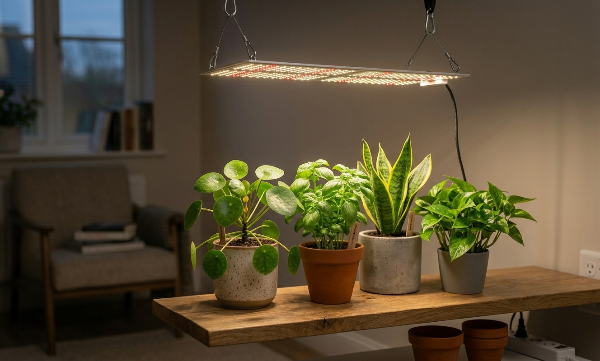
At around $80-$90 on Amazon, the Mars Hydro TS 600 sits in a category where the value-to-performance ratio is genuinely hard to beat. Despite the “600W” branding (a reference to its HPS equivalent, not actual power draw), it pulls around 100 actual watts from the wall. It covers a 2×3 foot (60×90 cm) footprint effectively at 18-24 inches (45-60 cm) hanging height and delivers enough PPFD for medium-to-high light plants that most basic bulbs or strips simply cannot match.
The TS 600 uses Samsung LM301B diodes, the same chip found in grow lights costing two to three times as much. That is why it performs above its price point. The spectrum leans warm-white with supplemental red, which produces compact, healthy vegetative growth without the blurple glow of cheaper panels.
Setup takes about 20 minutes. The light ships with hanging cables and a dimmer switch, which is more useful than it sounds: during the first two weeks with a new plant under this light, running it at 50-60% power and gradually stepping up prevents light shock, especially for plants that have been in low-light conditions for months.
What it lacks is waterproofing and the build quality finish of premium lights. The housing is plastic, not metal. The dimmer is manual rather than programmable. For $80, that is a reasonable trade-off.
Price range: $80-$95 Where to buy: Amazon, Mars Hydro website Coverage area: 2×3 feet (60×90 cm) at 18-inch (45 cm) height for vegetative growth
Worth noting: the Mars Hydro TS 600 runs slightly warm. Not hot enough to cause problems at normal hanging distances, but if you are placing it in an enclosed shelf unit rather than an open space, leave ventilation room above the fixture.
Pick 4: Spider Farmer SF-1000 LED – Best for Serious Indoor Plant Collections
Best for: Dedicated plant rooms, large collections of medium-to-high light plants, anyone who wants the most efficient, longest-lasting light in the mid-price range.
The Spider Farmer SF-1000 is what I would buy if I were starting fresh today and had a room or dedicated space for plants. It costs $100-$120, uses Samsung LM301B diodes, and draws only 100 watts of actual power while covering a 3×3 foot (90×90 cm) footprint at standard height. The energy efficiency here matters over time: grow lights run 12-16 hours a day, 365 days a year, and the difference between a cheap, inefficient panel and an efficient one adds up on your electricity bill.
Among the best grow lights for indoor plants at this price point, the SF-1000 stands out for three reasons. The light quality is genuinely full spectrum with a white-dominant spectrum rather than the pink-purple of cheaper LEDs. The build is solid metal housing with a Samsung/Mean Well driver, the kind of components that run reliably for 50,000 hours without degradation. And the light distribution is remarkably even across the full coverage area, with no major hot spots.
I currently run one of these over a collection of monsteras, an areca palm, and several trailing pothos in a spare bedroom that gets almost no natural light. Growth rates on the monsteras have been noticeably better than anything I achieved with cheaper options at similar distances.
The one honest limitation: the SF-1000 is visually utilitarian. This is a rectangular LED panel on hanging cables. It belongs in a plant room, a grow tent, or a setup where aesthetics take a back seat to performance. If you want something that looks good in your living room, that is the next pick.
Price range: $100-$120 Where to buy: Amazon, Spider Farmer website Coverage area: 3×3 feet (90×90 cm) vegetative, 2×2 feet (60×60 cm) for high-light plants like herbs
Read more: tropical indoor plants
Pick 5: Soltech Aspect Grow Light – Best Premium Aesthetic Pick
Best for: Living rooms and visible spaces where the light itself needs to look good, pendant lamp setups, people who refuse to compromise on decor.
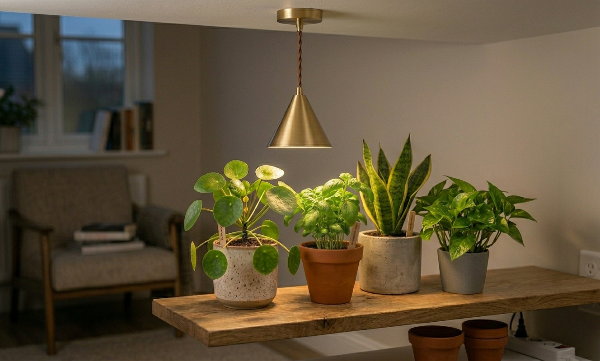
The Soltech Aspect is the one grow light in this list that does not look like a grow light. It ships as a pendant lamp with a fabric cord, a brass or matte black housing, and a warm, natural color temperature (around 2700K) that reads as an attractive accent lamp from across the room. Guests would not know it is a grow light unless you told them.
It is also expensive at $175-$200, and the PPFD output at typical pendant hanging heights is in the low-to-mid range. This is not the right choice for high-light plants. But for a statement plant, a small fiddle leaf fig, a large bird of paradise, or a grouping of tropical foliage plants in a dim corner of your living room, it provides enough light to maintain healthy growth while looking exactly like a piece of furniture rather than a piece of equipment.
Soltech has built a reputation among interior-plant enthusiasts for a reason. No other grow light at this level bridges the gap between function and aesthetics this cleanly. If budget is not the concern and appearance is, this is the pick.
Price range: $175-$200 Where to buy: soltechsolutions.com, Amazon Coverage area: Best for one large statement plant or two to three medium plants directly below
Side-by-Side Comparison
| Light | Best For | Price | Coverage | Spectrum | Aesthetics |
|---|---|---|---|---|---|
| GE BR30 Bulb | Single plants, beginners | $13-$18 | 1 plant | Full spectrum | Looks like a regular bulb |
| Barrina T5 Strips | Shelves, seedlings | $35-$45 (4-pack) | 2×4 ft shelf | Full spectrum (pink glow) | Utilitarian |
| Mars Hydro TS 600 | Mid-range panel, 10-20 plants | $80-$95 | 2×3 ft | Full spectrum, warm-white | Utilitarian |
| Spider Farmer SF-1000 | Serious collections | $100-$120 | 3×3 ft | Full spectrum, white-dominant | Utilitarian |
| Soltech Aspect | Living room, visible setups | $175-$200 | 1-3 plants | Warm full spectrum | Looks like a real lamp |
How Long Should You Run a Grow Light?
This question comes up constantly, and the answer depends on what you are supplementing. If your plants get some natural light during the day, even indirect light through a window, run the grow light for 12 hours, typically overlapping the daylight hours so the light-dark cycle stays consistent. If a plant is in a room with no natural light at all, 14-16 hours per day is the right target.
The single most important thing is consistency. Plants track light cycles and use them as biological cues. Running a grow light 8 hours Monday, 14 hours Tuesday, and skipping Wednesday entirely disrupts this. A basic mechanical outlet timer, around $10 at Home Depot, solves this entirely. Set it and forget it.
And keep darkness in the schedule. Plants need a rest period without light. Running a grow light 24 hours a day does not produce faster growth; it interferes with the plant’s respiration cycle and can actually slow things down.
5 Mistakes People Make with Grow Lights
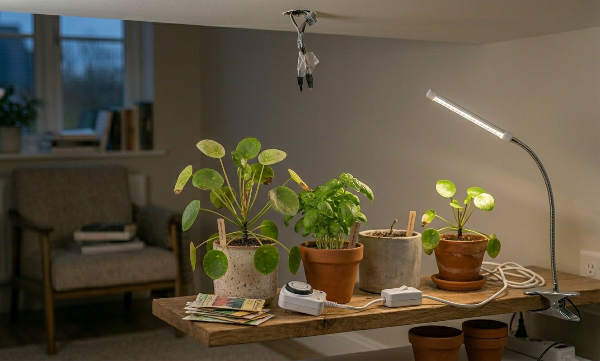
Positioning the light too far away. The most common setup mistake by a significant margin. Grow lights lose intensity rapidly with distance; the relationship is not linear but exponential. A light that delivers 300 PPFD at 12 inches (30 cm) may only deliver 80 PPFD at 24 inches (60 cm). Check the manufacturer’s recommended hang height and actually use it rather than placing the light wherever it is convenient.
Buying based on wattage alone. Wattage tells you how much electricity a light uses, not how much usable light it produces for plants. A 1000W HPS equivalent LED panel may draw only 100W from the wall. PAR output and PPFD at your growing distance matter far more than the wattage on the box.
Skipping the timer. Running a grow light manually is fine for a week. Six months in, you will forget it on overnight, or miss days entirely. Consistency in light cycles matters for plant health. A $10 outlet timer eliminates the variable entirely.
Moving plants abruptly from low light to a strong grow light. Plants acclimate to light intensity over time. A pothos that has lived in a dim corner for six months and is placed 12 inches under a 100W LED panel can experience light stress: bleaching, wilting, or stunted new growth. Start with the light farther away or at reduced intensity (if the light has a dimmer) and step it closer over two to three weeks.
Expecting a grow light to fix a plant that has a different problem. If a plant is yellowing from overwatering, root rot, or a nutrient deficiency, more light will not solve it. Grow lights supplement natural light for light-limited plants. They do not override other care issues. Diagnose before you buy.
Read more: root rot treatment
Frequently Asked Questions
What are the best grow lights for indoor plants if I am on a tight budget?
The GE BR30 Full Spectrum LED Grow Light Bulb is the best starting point at $13-$18. It screws into any standard lamp, covers one medium plant effectively, and produces real full-spectrum output. For a shelf of multiple plants, the Barrina T5 strip 4-pack at $35-$45 covers more area for less per plant. Both are available at Home Depot, Lowe’s, or Amazon.
How far should a grow light be from my plants?
It depends on the light’s intensity and the plant’s light needs. As a general starting point: LED panels like the Spider Farmer SF-1000 and Mars Hydro TS 600 work well at 18-24 inches (45-60 cm) above the canopy for medium-light plants, and 12-16 inches (30-40 cm) for high-light plants like herbs and succulents. Bulbs and strip lights, which have lower output, should be positioned 6-18 inches (15-45 cm) away. Always check the manufacturer’s PPFD chart for your specific light.
How many hours a day should I run a grow light for indoor plants?
For plants that receive some natural light, 12 hours per day is the standard target. For plants in rooms with no windows or minimal natural light, 14-16 hours works well. Use a timer to keep the schedule consistent. Always include a dark period: running lights 24 hours a day does not help and can disrupt the plant’s natural cycle.
Are grow lights worth it for low-light houseplants like pothos and snake plants?
Yes, but you do not need a powerful or expensive one. Low-light plants like pothos, snake plants, ZZ plants, and peace lilies do fine with the output from a single GE BR30 bulb or one Barrina strip positioned 12-18 inches (30-45 cm) away. The benefit shows up in faster growth, better color, and less stretching toward the nearest window. For true low-light species, a modest light supplementing a dim room is enough.
Can I use regular LED lights instead of grow lights?
Regular warm-white LED bulbs (2700K) produce almost no blue spectrum, which plants need for vegetative growth. Regular cool-white LEDs (5000-6500K) are slightly better but still lack the red spectrum balance that full-spectrum grow lights provide. Purpose-built grow lights are optimized specifically for plant photosynthesis. The price difference between a regular LED bulb and the GE BR30 grow bulb is a few dollars. It is worth paying for the right tool.
Do grow lights raise my electricity bill significantly?
Less than most people expect. The GE BR30 uses 9 watts. Running it 14 hours a day for a full month costs roughly $0.40-$0.60 depending on your electricity rate. Even the Spider Farmer SF-1000 at 100 watts, run 14 hours a day for a month, adds around $5-$7 to a typical monthly bill. Over a year that is roughly $60-$84 for a high-performing panel, which is reasonable compared to what it costs to replace plants that die from light deprivation.
What is the best grow light for indoor plants in a living room setting?
The Soltech Aspect. It is the only one in this guide designed to look like a real pendant lamp rather than grow equipment. For a living room where the light is visible and aesthetics matter, no other option comes close at this level. If the $175-$200 price point is too high, the GE BR30 in an attractive floor lamp is the next best option for keeping the setup looking intentional rather than improvised.
Which grow light is best for high-light plants like herbs, succulents, or citrus indoors?
High-light plants need PPFD levels in the 400-600 range or higher, which rules out single bulbs and strips as the sole light source. For herbs, succulents, and citrus grown indoors, the Spider Farmer SF-1000 or the Mars Hydro TS 600 at 12-18 inches (30-45 cm) above the canopy provides the intensity these plants need to thrive, not just survive.
The Bottom Line
There is no single best grow light for every grower. There is a best grow light for your plants, your space, your budget, and how much you care about what the setup looks like on a Tuesday evening when guests come over.
Start with what fits your situation right now. The GE BR30 if you are testing the idea with one or two plants. The Barrina strips if you are building a shelf setup. The Spider Farmer SF-1000 if you are serious about your collection and have the space. The Soltech Aspect if your living room will not forgive anything less than something beautiful.
All five of these picks are genuinely good. None of them will disappoint you if matched to the right situation. And once you start growing plants under proper light, it is hard to go back.
Happy planting.
Read more: best planters for indoor plants
1 thought on “Best Grow Lights for Indoor Plants 2026: Picks for Every Budget”