
The most common mistake beginners make with pothos is overwatering it while trying to care for it perfectly. They water it every few days, the soil stays wet, the roots suffocate and rot, and the plant that was supposed to be unkillable starts dropping yellowing leaves within a month. Pothos plant care is genuinely forgiving, but it is not accident-proof, and the specific mistakes that hurt it are consistent enough that knowing them upfront saves a lot of frustration. I have grown more than a dozen pothos varieties in different rooms, light conditions, and seasons, and what I found is that pothos plant care rewards a lighter touch more than any other houseplant I have owned.
Water less than you think you need to. Prune more often than feels necessary. Give it the brightest light your space allows rather than settling for a dark corner. Do those three things and pothos plant care becomes something you barely have to think about.
| Aspect | Details |
|---|---|
| Botanical Name | Epipremnum aureum |
| Common Names | Pothos, Devil’s Ivy, Golden Pothos, Money Plant (in parts of Asia) |
| Plant Family | Araceae |
| Native Region | Southeast Asia and Pacific Islands (Mo’orea, French Polynesia) |
| Light | Low to bright indirect light; 4-6 hours daily ideal |
| Water | When top 1-2 inches (2.5-5 cm) of soil feel dry |
| Humidity | 40-60% (tolerates average indoor levels) |
| Temperature | 65-85 degrees F (18-29 degrees C) |
| Soil | Well-draining potting mix with perlite |
| Mature Size Indoors | Vines 6-10 feet (1.8-3 meters) long; leaves 2-4 inches (5-10 cm) |
| Mature Size Outdoors | Vines 30-40 feet (9-12 meters) in tropical climates |
| Growth Rate | Fast — several inches per week in good conditions |
| Toxicity | Toxic to cats, dogs, and humans (ASPCA) |
| Difficulty Level | Beginner |
| USDA Zones | 10-12 outdoors; houseplant everywhere |
Why Pothos Is One of the Best Indoor Plants You Can Own
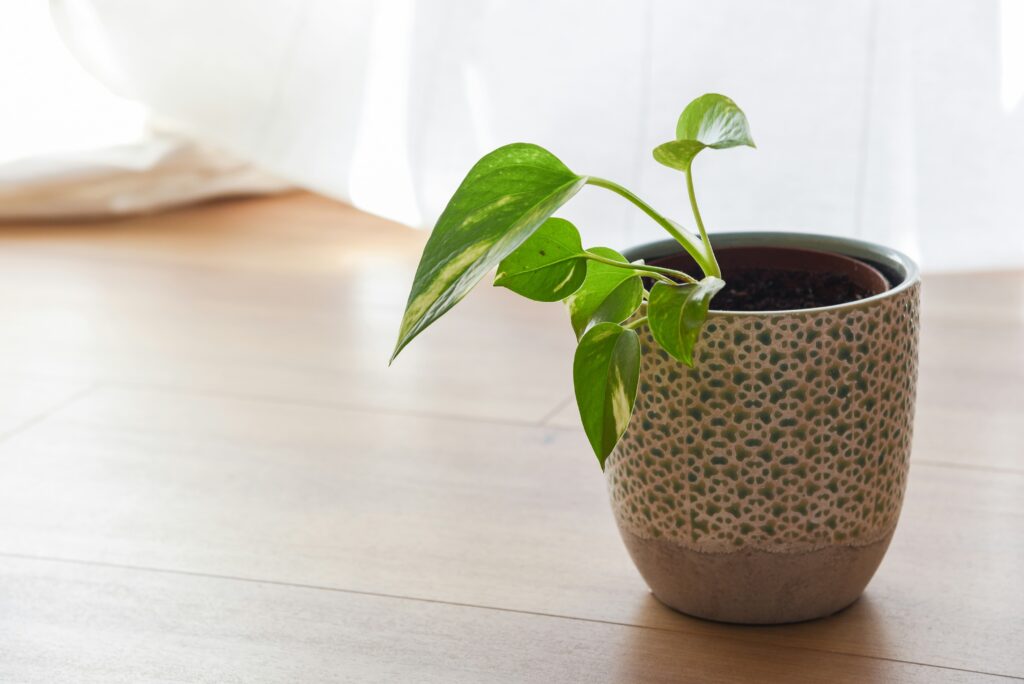
Pothos plant care has attracted a loyal following because few plants offer this combination at any price: fast visible growth, dramatic trailing aesthetics, tolerance for low light, resilience through missed waterings, and air-purifying properties documented in NASA’s Clean Air Study. In practical terms, what this means is that a pothos planted on a shelf in a room with a single north-facing window in a rental apartment can grow 3 to 4 feet (90 to 120 cm) of new vine in a single summer without any specialized equipment. No grow lights, no humidity trays, no fertilizer schedule — just a pot, some soil, and basic watering. That combination is why pothos consistently appears on every beginner plant list, every “unkillable plants” article, and every recommendation when someone asks what to buy for their first houseplant. It is genuinely as forgiving as the reputation suggests, but understanding the specific care requirements that push it from surviving to thriving makes a significant visible difference in leaf size, vine density, and color saturation. Pothos plant care done correctly produces plants with leaves 4 to 6 inches (10 to 15 cm) wide rather than the 2-inch leaves of a neglected specimen in a dark corner.
Pothos Varieties: Choosing the Right One for Your Space
Pothos plant care is broadly consistent across varieties, but the varieties themselves differ significantly in light needs, growth speed, and visual impact. Here is what you need to know before choosing:
| Variety | Leaf Color | Light Need | Growth Speed | Best For |
|---|---|---|---|---|
| Golden Pothos | Green with yellow streaks | Low to bright indirect | Very fast | Beginners, any light condition |
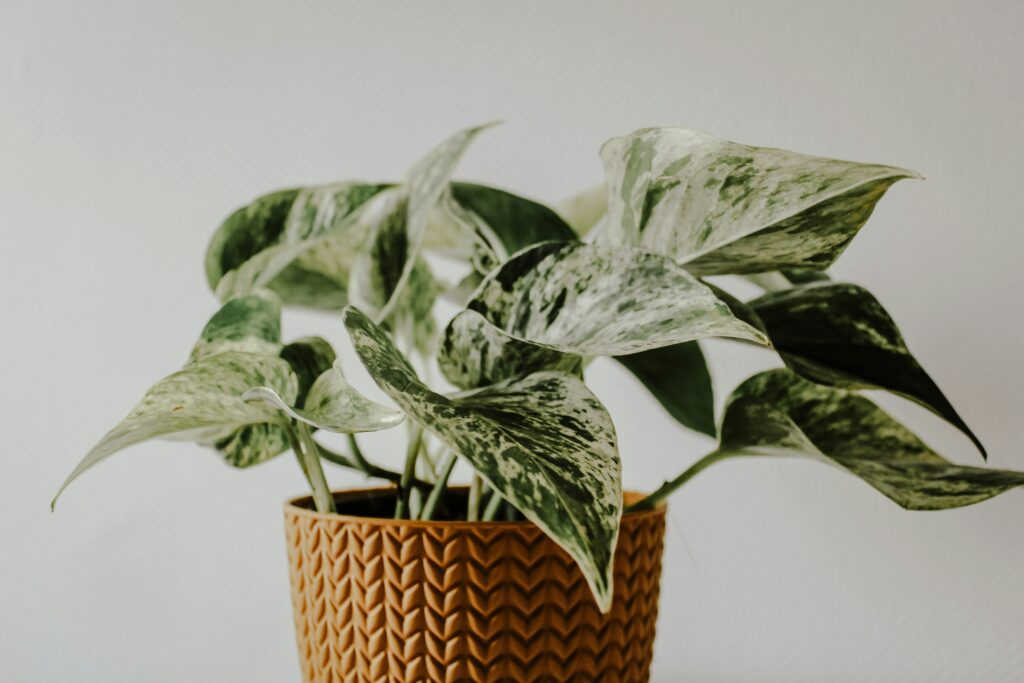
| Marble Queen | White and cream variegation | Medium to bright indirect | Moderate | Bright rooms, visual impact |
| Neon Pothos | Bright chartreuse/lime green | Medium to bright indirect | Fast | Color contrast, modern interiors |
| Jade Pothos | Solid deep green | Low to medium indirect | Fast | Dark rooms, low light areas |
| N’Joy | Green and white patches | Medium to bright indirect | Moderate | Compact spaces, windowsills |
| Pearls and Jade | White with green speckles | Medium to bright indirect | Slow | Shelves, slower spreading |
| Cebu Blue | Silver-blue (fenestrations when mature) | Medium to bright indirect | Moderate | Statement plant, mature display |
| Manjula | Cream, white, and green curled leaves | Bright indirect | Slow | Rare variety collectors |
| Baltic Blue | Blue-green (fenestrations as it matures) | Medium to bright indirect | Moderate | Modern interiors |
The most widely available varieties at Home Depot, Lowe’s, Trader Joe’s, and online through The Sill are Golden Pothos, Marble Queen, and Neon. If you are starting pothos plant care for the first time, Golden Pothos is the most resilient option by a significant margin. It grows fast in almost any light condition and bounces back from care mistakes faster than the more finicky variegated types. For a broader comparison of pothos versus its closest look-alike, our guide on pothos vs philodendron explains the exact visual and care differences that trip up most beginners.
Pothos Plant Care: Light Requirements
Pothos plant care is most often credited with being a low-light plant, and while that is technically accurate, it creates an unrealistic expectation that leads to disappointing results. Pothos tolerates low light it will not die in a dark corner but pothos plant care in low light produces small, widely spaced leaves on thin vines rather than the lush, densely-leaved trailing plant that most people are trying to grow. For the best leaf size, variegation color, and growth speed, aim for medium to bright indirect light for 4 to 6 hours daily. A spot within 3 to 6 feet (90 to 180 cm) of a window that receives good morning or afternoon light is ideal for most varieties. East-facing windows provide gentle morning sun that suits pothos perfectly without any risk of leaf scorch. West and south-facing windows provide stronger light that pothos handles well as long as direct midday sun is filtered by a sheer curtain, because direct intense sun bleaches and scorches the leaves. Variegated varieties like Marble Queen and Pearls and Jade specifically need more light than the all-green or predominantly-green varieties because the white or cream portions of the leaf contain no chlorophyll and cannot contribute to photosynthesis. In low light, a Marble Queen loses its variegation and produces increasingly green new leaves as the plant compensates for insufficient light.
Pro Tip: Rotate your pothos a quarter turn every two weeks. All pothos varieties grow toward the light source, and without rotating, one side of the plant will become significantly fuller than the other within a growing season.
Pothos Plant Care: Watering the Right Way
The watering section of any pothos plant care guide should come with one overriding rule: check before you water. Not “water every seven days,” not “water twice a week in summer,” just check the soil each time you are considering watering and let the plant tell you what it needs. Push your finger 1 to 2 inches (2.5 to 5 cm) into the potting mix. If the soil at that depth feels moist and cool, put the watering can down and come back in two or three days.
If it feels dry and crumbly, water thoroughly until it drains freely from the drainage hole, then let it drain completely before returning the pot to its spot. In spring and summer, this typically means watering every 7 to 10 days for a medium-sized pothos in a plastic pot near a bright window. In winter, when growth slows and the soil dries much more slowly, that same plant might go 14 days or longer between waterings without any stress. The single most common error in pothos plant care is treating winter the same as summer and continuing to water at the same frequency as growth slows.
Overwatered pothos shows yellow leaves, soft stems, and soil that never fully dries. Underwatered pothos shows crispy brown leaf edges and wilting that resolves quickly after watering. To understand the visual difference between these two conditions before they become serious, our guide on overwatering vs underwatering covers every diagnostic symptom with clear descriptions.
Pothos Plant Care: Soil and Container Selection
The soil and container decisions you make when setting up pothos plant care determine how well every other aspect of care works. Pothos grows in standard indoor potting mix, and it does not need a specialized blend, but the default potting mix available at most stores holds moisture longer than what is ideal for consistent root health. My approach is to take any standard mix, such as Miracle-Gro Indoor Potting Mix or FoxFarm Ocean Forest, and amend it with 20 to 30 percent perlite by volume.
The perlite keeps the mix from compacting over time and allows oxygen to reach the roots between waterings, which is what prevents the root rot that kills more pothos plants than any other cause. For a full comparison of soil mixes and amendment ratios for different plant types, our guide on best soil for indoor plants covers every option available at US garden centers. For the container itself, any pot with drainage holes works for pothos plant care. Terra cotta pots dry out faster and give you a wider margin for error on watering, which is helpful if you tend to overwater.
Plastic pots retain moisture longer, which can be beneficial if your home is particularly dry or if you tend to underwater. Avoid oversized containers: a pot that is significantly larger than the root ball holds more soil than the roots can draw moisture from quickly, creating wet soil conditions around the roots that cause rot even with responsible watering.
Temperature, Humidity, and Pothos Plant Care
Pothos plant care has relatively minimal requirements around temperature and humidity compared to other tropical houseplants like calatheas or orchids, which is part of what makes it such a practical indoor plant for most US homes. The comfortable temperature range for pothos is between 65 and 85 degrees F (18 to 29 degrees C), which covers the typical range of a heated and cooled American home throughout the year. Pothos tolerates brief dips to 55 degrees F (12 degrees C) without significant damage, but prolonged exposure to cold below 50 degrees F (10 degrees C) causes the leaves to yellow and drop rapidly.
Keep pothos away from exterior doors, drafty windows in winter, and air conditioning vents that blast cold air directly onto the leaves during summer. For humidity, pothos handles the 40 to 50 percent relative humidity of most US homes without any supplemental help, which is one of its biggest practical advantages over high-humidity tropical plants. That said, if you notice persistent brown leaf tips that are not related to watering, running a small humidifier in the same room will improve leaf appearance and growth speed noticeably during the dry winter heating months.
Fertilizing Pothos for Faster Growth and Better Color
Fertilizing is the part of pothos plant care that most beginners either skip entirely or overdo, and both extremes produce worse results than a simple, consistent routine. Pothos does not need heavy feeding, but it responds visibly to regular light feeding during the growing season in a way that makes a real difference to leaf size and vine density. From early spring through late summer, apply a balanced liquid fertilizer at half the recommended label strength once every four weeks. Jack’s Classic All Purpose 20-20-20 or Espoma Organic Indoor Plant Food are reliable options available at most garden centers and on Amazon.
The half-strength application avoids the salt buildup that causes leaf tip burn in pothos, which is one of the most common problems I see in plants that have been fertilized at full strength for several months. Stop fertilizing from October through February. During winter dormancy, unused fertilizer accumulates in the soil as mineral salt, and this buildup damages roots and shows up visually as white crusty deposits on the soil surface. If you see mineral crust forming, flush the entire pot with plain water at the sink for a full minute before applying any new fertilizer the following spring.
Pruning and Training Your Pothos Vines
Regular pruning is the single most overlooked element of pothos plant care, and it is the main reason most pothos plants end up looking sparse and one-sided rather than full and bushy. Without pruning, pothos puts all its energy into extending existing vines to maximum length rather than producing new growth points near the base. The result is a few very long, thin vines with leaves spaced widely apart. Pruning regularly forces the plant to branch below each cut point, which creates more vine tips, more leaf nodes, and ultimately a much fuller plant. Cut stems just above a leaf node using clean, sharp scissors.
You can cut as much as one-third of the plant in a single session without stressing it. The cut sections make excellent propagation material, which is covered in detail in our beginner-friendly guide on propagating pothos plants growing new plants from cuttings takes about two weeks and costs nothing. For directional training, pothos accepts most structures willingly. A simple shelf position where vines trail downward is the easiest. A mounted board or moss pole mounted on a wall allows upward climbing, which produces progressively larger leaves as the plant matures and attaches aerial roots.
Common Pothos Plant Care Problems and How to Fix Them
Understanding the most common issues in pothos plant care saves the plant before problems become serious. Here is what each problem looks like and what causes it:
Yellow leaves spreading from the bottom upward almost always indicate overwatering. Check the soil moisture immediately and reduce watering frequency. If the soil has been wet for an extended period, check the roots for soft, dark rot tissue. For a full breakdown of what every yellowing pattern means across different causes, our guide on plant leaves turning yellow covers the diagnosis and fix for each specific pattern.
Brown, crispy leaf edges point to one of three things: underwatering, very dry air, or fluoride/mineral buildup from tap water. Check the soil first. If it is bone dry, water more consistently. If moisture is adequate but the air in your home is dry from winter heating, increase humidity. If water quality is the issue, switch to filtered or distilled water.
Root rot is identifiable by wilting that does not resolve after watering, soft dark roots visible when the plant is removed from the pot, and a sour smell from the soil. Remove the plant, trim all affected roots with clean scissors, let the root system air dry for 30 minutes, and repot into fresh well-draining soil. Our guide on root rot treatment covers every step of this process in detail, including how to assess whether a plant is saveable before you begin.
Small, pale leaves with long gaps between nodes indicate insufficient light. Move the plant progressively closer to a window over one to two weeks rather than all at once, which minimizes the leaf drop that sometimes accompanies a sudden environmental change.
Pest infestations primarily mealybugs and spider mites appear most often during winter when indoor air is dry. Mealybugs look like white cottony clusters in stem junctions. Spider mites produce fine webbing and tiny pale dots on leaf surfaces. Both respond to a weekly application of insecticidal soap spray applied to the undersides of leaves, continued for three to four weeks to break the pest life cycle.
Is Pothos Toxic to Cats and Dogs?
Pothos plant care in a home with pets requires specific placement awareness. According to the ASPCA, pothos is toxic to cats, dogs, and horses. The plant contains calcium oxalate crystals that cause immediate oral irritation, excessive drooling, vomiting, and difficulty swallowing if ingested. The reaction is painful and fast-acting rather than slowly cumulative, so the risk is not from small accidental exposures over time but from a pet chewing on a stem or leaf.
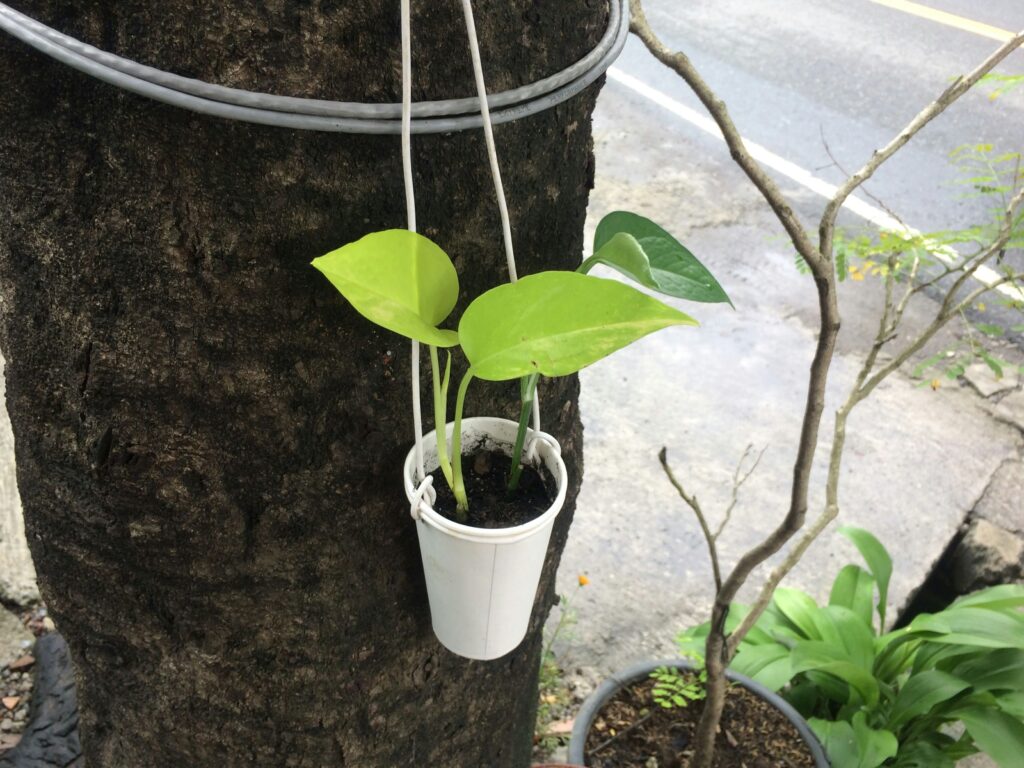
Place pothos in hanging baskets, on high shelves, or trained up a wall mount that is genuinely out of reach of curious pets. If you want trailing plants at floor level or on low surfaces in a pet-friendly home, our guide on indoor plants safe for cats covers 15 confirmed non-toxic options with similar trailing or low-maintenance growth habits.
Pothos Plant Care Mistakes That Beginners Make Most Often
- Watering on a fixed schedule. Pothos plant care requires checking the soil, not following a calendar. The actual drying time changes with season, light level, pot material, and pot size. Seven days works in summer; fourteen or more may be needed in winter.
- Leaving the plant in a dark corner hoping it will “just survive.” Pothos tolerates low light but produces visibly smaller, paler, more widely-spaced leaves. If you want lush, impressive pothos plant care results, the plant needs medium to bright indirect light.
- Not pruning. A pothos that is never pruned becomes a plant with two or three very long, sparse vines rather than a full, bushy specimen. Prune regularly at the nodes, and the plant will reward you with noticeably denser growth within weeks.
- Using a pot without drainage holes. Pothos in any closed container, regardless of how carefully you water, is at permanent risk of root rot because excess water has nowhere to exit. Every pot used for pothos plant care must have drainage holes.
- Putting all varieties in the same light conditions. Golden and Jade Pothos handle low light well. Marble Queen, Manjula, and Pearls and Jade all need significantly more light to maintain their variegation. Treating all pothos the same regardless of variety is one of the most consistent reasons variegated types look dull in homes where the solid-green types look great.
FAQs
How often should I water my pothos plant?
The correct watering frequency in pothos plant care depends on your specific conditions more than any fixed schedule. In summer near a bright window, most pothos plants need water every 7 to 10 days. In winter in a cooler room with less light, the same plant may go 14 to 18 days between waterings. Always check the soil at the 1 to 2 inch (2.5 to 5 cm) depth before watering. If it is still moist, wait.
Why are my pothos leaves turning yellow?
Yellowing in pothos plant care is most commonly caused by overwatering and soggy roots. Check whether the soil has been consistently wet and reduce your watering frequency. Less commonly, yellowing results from insufficient light or nutrient deficiency after months without fertilizing. The location of the yellow leaves matters: lower, older leaves yellowing occasionally is normal aging. New growth yellowing while older growth stays green points to a nutrient or light issue.
Is pothos plant care easy for total beginners?
Yes. Pothos plant care is one of the easiest plant care routines available, which is why it consistently appears on every beginner plant list. Its tolerance for missed waterings, low light, and imperfect conditions makes it forgiving of the learning curve that every new plant owner goes through. The main mistakes beginners make — overwatering, putting it in a completely dark spot — are easy to avoid once you know to watch for them.
How fast does pothos grow?
In active pothos plant care conditions with medium to bright indirect light and monthly fertilizing during spring and summer, pothos can produce several inches of new vine growth per week. Under lower light without fertilizing, growth slows to a few inches per month. Neon and Golden Pothos are the fastest growers among the common varieties. Marble Queen, Pearls and Jade, and Manjula grow more slowly regardless of conditions.
Can pothos grow in water permanently?
Yes. Pothos roots readily in water and can survive indefinitely in a vase or jar of water as long as the water is changed every one to two weeks to prevent stagnation and algae buildup. Water-grown pothos develops different roots adapted to aquatic conditions and generally cannot be transferred to soil without a difficult transition period. It is best to decide upfront whether you want water or soil pothos plant care rather than switching between the two.
Does pothos clean the air?
Pothos was included in NASA’s Clean Air Study and found to remove formaldehyde, benzene, and carbon monoxide from enclosed indoor environments. In a typical home, the improvement in air quality from a single pothos is modest rather than dramatic. Multiple plants across multiple rooms produce a more meaningful effect. What the plant does reliably and measurably is remove VOCs that off-gas from furniture, paint, and cleaning products in enclosed spaces.
How do I make my pothos plant fuller and bushier?
The fastest way to make pothos fuller through regular pothos plant care is to prune stems back to just above a leaf node consistently rather than letting vines grow as long as possible. Each cut creates two or more new growing points below it. Moving the plant to a brighter light position also produces noticeably smaller gaps between leaves and more vigorous branching without any pruning needed.
Pothos plant care is a genuinely rewarding practice because this plant responds visibly to good conditions within weeks. Move it to a brighter spot and the next leaves come in larger and more vividly colored. Prune it back and the plant doubles its branching points within a month. Start fertilizing in spring and the growth rate jumps noticeably. None of this requires expert-level knowledge or expensive equipment. It just requires paying attention to the plant rather than following a rigid schedule, and adjusting one thing at a time when something looks off.
That approach check the soil, read the leaves, make one change, observe the result is the foundation of good pothos plant care, and it is the same approach that works for almost every other houseplant you will ever own.
Happy planting!