
Are you fertilizing your houseplants wrong? Most indoor plant owners either skip fertilizing entirely or reach for whatever is on the shelf at Home Depot without understanding what their plants actually need from a fertilizer. The result is either nutrient-starved plants that grow slowly and look dull, or over-fertilized plants with salt-burned leaf tips and damaged roots. Choosing the best fertilizer for houseplants does not require a chemistry degree, but it does require understanding three numbers on every fertilizer label, the difference between product types, and which plants need what. This guide cuts through the noise and gives you specific, honest recommendations based on plant type, season, and growing experience.
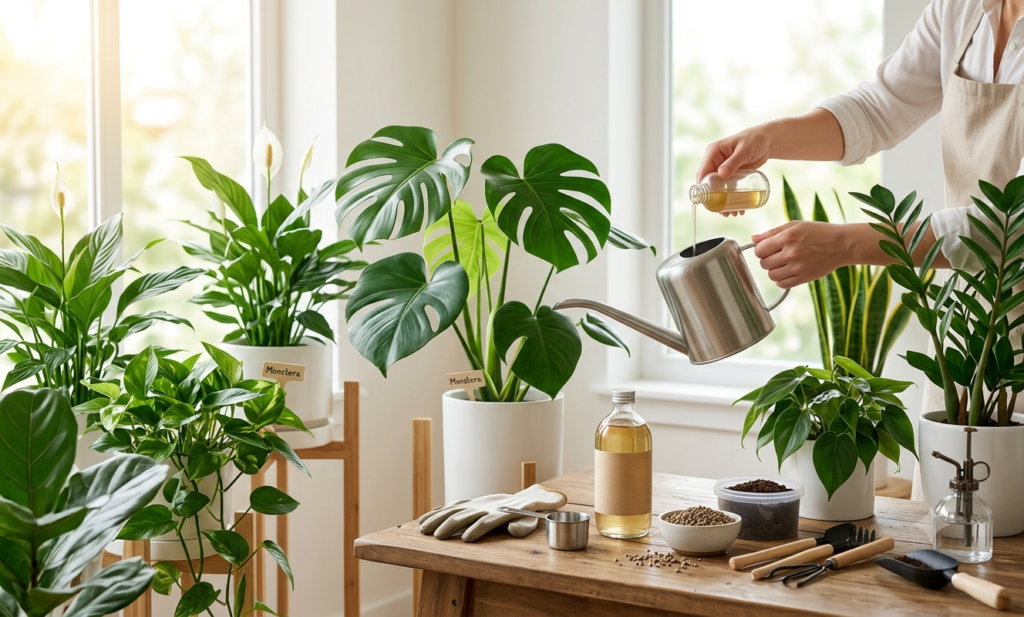
Understanding NPK: The Three Numbers on Every Fertilizer Label
Before any product recommendation makes sense, you need to know what NPK means, because the best fertilizer for houseplants depends entirely on these three numbers.
Every fertilizer label shows three numbers separated by hyphens. Those numbers represent the percentage by weight of:
- N (Nitrogen): Drives leafy, vegetative growth. High nitrogen = more leaves, bigger stems, faster growth. Plants grown primarily for foliage pothos, monstera, snake plan benefit most from balanced-to-high nitrogen.
- P (Phosphorus): Supports root development and flower production. Higher phosphorus = stronger roots, better blooms. Flowering houseplants like peace lily and anthurium benefit from elevated phosphorus.
- K (Potassium): Regulates overall plant health, water uptake, and disease resistance. Potassium matters more than most beginner guides acknowledge low potassium leads to weak, soft growth even when nitrogen and phosphorus are adequate.
A balanced fertilizer (20-20-20 or 10-10-10) delivers equal amounts of all three and works well as a general-purpose choice for most houseplants. A bloom-booster formula (10-30-20) shifts toward phosphorus and potassium, which suits flowering plants better. A foliage fertilizer (24-8-16) leans toward nitrogen and suits fast-growing tropical foliage plants specifically.
Best Fertilizer for Houseplants: Product Picks by Type
Liquid Fertilizers – Best for Active Growing Season
Liquid fertilizers are the most controllable format. You dilute them before applying, which lets you adjust concentration based on plant size, growth rate, and season. Apply every 2 to 4 weeks during spring and summer. Always dilute to half the label strength to avoid salt buildup.
| Product | NPK | Best For | Price Range | Where to Buy |
|---|---|---|---|---|
| Jack’s Classic All Purpose 20-20-20 | 20-20-20 | All foliage houseplants | $15-25 (1.5 lb) | Amazon, Ace Hardware |
| Jack’s Classic Blossom Booster 10-30-20 | 10-30-20 | Flowering houseplants | $15-25 (1.5 lb) | Amazon |
| Miracle-Gro Indoor Plant Food | 1-1-1 | Beginners, frequent feeding | $5-10 | Home Depot, Walmart |
| Espoma Organic Indoor! | 2-2-2 | Organic growers | $8-15 | Lowe’s, Amazon |
| FoxFarm Grow Big 6-4-4 | 6-4-4 | Fast-growing tropicals | $18-25 | Amazon, nurseries |
My pick for most indoor plants: Jack’s Classic All Purpose 20-20-20 at half strength, applied once every 4 weeks during the growing season. It delivers balanced nutrition without the salt buildup that cheaper options cause at full strength. For tropical foliage plants like areca palm, croton, and monstera — all of which are heavy feeders — this formula handles the growing season reliably. See our areca palm care guide and croton plant care guide for how fertilizing fits into the full seasonal care routine for both of those plants.
Slow-Release Granular Fertilizers — Best for Low-Maintenance Growing
Slow-release fertilizers are coated granules that break down gradually over 3 to 6 months, releasing nutrients with each watering. You apply them once at the start of spring and essentially forget about feeding until fall. The trade-off: less control over timing, and you cannot remove them if you accidentally over-apply.
| Product | NPK | Duration | Best For | Price |
|---|---|---|---|---|
| Osmocote Plus 15-9-12 | 15-9-12 | 6 months | All houseplants | $10-18 (8 oz) |
| Miracle-Gro Shake ‘N Feed 12-4-8 | 12-4-8 | 3 months | Foliage plants | $8-14 |
| Jobe’s Organics All Purpose 4-4-4 | 4-4-4 | 2-3 months | Organic preference | $8-12 |
| Nutricote 13-13-13 | 13-13-13 | 3-4 months | Tropical plants | $12-18 |
Best pick: Osmocote Plus 15-9-12 is the most consistently reliable slow-release formula for indoor houseplants. The 15-9-12 ratio favors growth without being so nitrogen-heavy that it pushes weak, leggy stems. Apply half the label-recommended amount to indoor containers — indoor plants absorb fertilizer more slowly than outdoor plants because of reduced light and lower soil microbial activity.
Fertilizer Spikes — Most Convenient, Least Accurate
Fertilizer spikes insert directly into the soil near the roots. They are the most convenient option and the least precise. Nutrients concentrate around the spike rather than distributing evenly through the root zone, which can cause localized salt buildup. They work acceptably for low-maintenance growers who want simplicity over optimization.
| Product | NPK | Duration | Best For |
|---|---|---|---|
| Jobe’s Houseplant Food Spikes 13-4-5 | 13-4-5 | 2 months | Foliage plants |
| Miracle-Gro Spike 6-12-6 | 6-12-6 | 2 months | Flowering plants |
Use fertilizer spikes as a last resort if liquid or slow-release options are genuinely inconvenient. For most indoor plant owners, the effort difference between spikes and liquid fertilizer is minimal once you establish a routine.
Organic Fertilizer Options
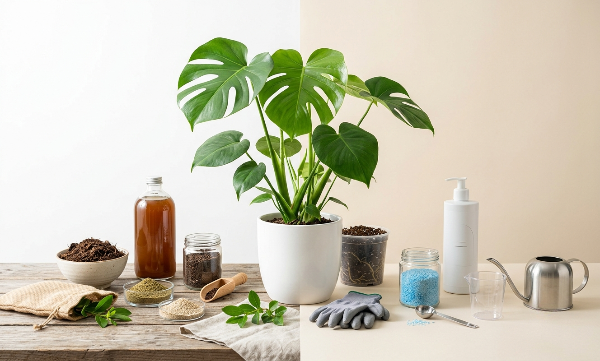
Organic fertilizers release nutrients more slowly than synthetic options and improve long-term soil biology rather than just delivering a nutrient hit. The trade-off is lower and less predictable nutrient availability, which matters more for fast-growing plants than slow ones.
| Product | NPK | Type | Best For |
|---|---|---|---|
| Espoma Organic Indoor! 2-2-2 | 2-2-2 | Liquid | General use, organic preference |
| Dr. Earth Premium Gold 4-4-4 | 4-4-4 | Granular | Slow-growing plants, succulents |
| Neptune’s Harvest Fish & Seaweed 2-3-1 | 2-3-1 | Liquid | All plants, soil biology boost |
| Worm castings (no set NPK) | ~1-0-0 | Amendment | Soil conditioning, slow nutrition |
Best organic pick: Espoma Indoor! is the most accessible organic liquid fertilizer for houseplants, available at most Lowe’s and garden centers. It will not push the growth speed of a synthetic fertilizer but maintains consistent background nutrition without any risk of burn.
Best Fertilizer for Houseplants: Matched by Plant Type
| Plant Type | Recommended Formula | Frequency | Notes |
|---|---|---|---|
| Tropical foliage (monstera, pothos, philodendron) | 20-20-20 at half strength | Every 4 weeks, spring-summer | Stop in winter |
| Areca palm, bird of paradise | 15-9-12 slow release | Once in spring | Heavy feeders |
| Succulents and cacti | 5-10-10 or half-strength balanced | Every 6-8 weeks, summer only | Never in winter |
| Snake plant, ZZ plant | 10-10-10 at quarter strength | Every 6-8 weeks | Light feeders only |
| Flowering plants (peace lily, anthurium) | 10-30-20 blossom booster | Every 4 weeks, spring-fall | Phosphorus supports blooms |
| Croton | 20-20-20 at half strength | Every 4 weeks, spring-summer | Heavy feeder during growing season |
| Orchids | Orchid-specific 20-20-20 at quarter strength | Every other week, growing season | Never dry feed |
| African violet | High-phosphorus formula | Every 2 weeks | Stop when not flowering |
For the complete seasonal fertilizing schedule for croton and monstera specifically, see our croton plant care and monstera plant care guides, which cover fertilizing as part of the full year-round care routine.
When and How to Use the Best Fertilizer for Houseplants
When: Fertilize only during the active growing season — early spring through late summer. Most indoor plants slow or stop growing from October through February, and fertilizer applied during this period accumulates as mineral salt in the soil rather than being absorbed.
How to apply liquid fertilizer correctly:
- Water the plant thoroughly first. Never apply fertilizer to dry soil undiluted nutrients hitting dry roots cause immediate burn damage.
- Mix fertilizer at half the label strength. The recommended concentration on most labels is calibrated for outdoor conditions with higher light and faster growth. Half strength prevents the buildup that causes brown leaf tips.
- Apply to the soil, not the leaves. Foliar feeding works for some plants, but leaf surface application on most common houseplants does more cosmetic damage than nutritional benefit.
- Repeat every 2 to 4 weeks through summer. Monthly is the right default for most plants. Heavy feeders like monstera, pothos, and croton can handle every 3 weeks. Light feeders like snake plant and ZZ plant do better at every 6 weeks.
How to apply slow-release granules:
- Sprinkle granules on the soil surface at half the label rate
- Work them lightly into the top inch of soil with a finger or small tool
- Water thoroughly after application
- Reapply after the stated duration (usually 3 to 6 months), but only if still in the growing season
Signs Your Houseplant Needs Fertilizer
If you are uncertain whether to fertilize, these signals tell you the plant is running low on nutrients:
- New leaves are noticeably smaller than older leaves from the same plant
- Growth has slowed or stopped entirely despite adequate light and correct watering
- Older leaves are yellowing from the bottom upward without overwatering as a cause
- Leaf color looks pale or washed out compared to how it looked when purchased
- The plant has not been repotted in over two years and is using depleted soil
Yellowing that looks nutrient-related but affects all leaves simultaneously more often indicates a watering or root issue rather than a fertilizer need. Our guide on plant leaves turning yellow covers how to diagnose the specific cause before adding fertilizer to an already-stressed plant. Adding fertilizer to a plant with root damage makes the problem significantly worse.
Common Fertilizing Mistakes to Avoid
Fertilizing in winter. The plant cannot use the nutrients. They accumulate as salt, show up as white crust on the soil surface, and damage roots. The fix: flush the soil thoroughly in early spring to clear the buildup before the growing season begins.
Applying at full label strength. Label concentrations are calibrated for outdoor nursery production, not indoor houseplants. Half strength is the correct default. Quarter strength is right for sensitive plants like orchids and cacti.
Fertilizing a plant that is already sick. If the plant has root rot, overwatering damage, or a pest infestation, fertilizing does not help. It adds nutritional stress to a plant already under physical stress. Fix the underlying problem first, wait for stable new growth, then resume feeding.
Using the same fertilizer for every plant regardless of type. A bloom-booster formula used on a foliage-only plant pushes root development at the expense of the leaf growth you are actually trying to encourage. Match the NPK ratio to what that specific plant is growing for.
Switching products too frequently. The best fertilizer for houseplants is any quality formula you use consistently through the growing season. Switching products every few weeks based on tips or recommendations without giving any product a full season to show results prevents you from learning what actually works in your specific conditions.
FAQ
What is the best fertilizer for houseplants overall?
For most common foliage houseplants, Jack’s Classic All Purpose 20-20-20 diluted to half strength and applied monthly during spring and summer is the most reliable choice. It delivers balanced nutrition, dissolves completely without residue, and is widely available on Amazon and at garden centers. For beginners who want something simpler, Miracle-Gro Indoor Plant Food at half strength works consistently and is sold at every Home Depot and Walmart.
Can I use outdoor fertilizer for indoor houseplants?
Yes, with an important adjustment: always reduce the concentration to half or quarter strength. Outdoor fertilizer formulas are calibrated for plants growing in higher light with faster growth rates. The same concentration applied to a low-light indoor plant causes salt buildup and leaf tip burn within a few applications. The NPK ratio from outdoor formulas works fine indoors; the concentration is what needs adjusting.
How often should I fertilize my houseplants?
Most houseplants do well with fertilizing every 4 weeks during spring and summer. Heavy feeders like monstera, croton, and areca palm can be fertilized every 3 weeks during peak growth. Light feeders like snake plant, ZZ plant, and cacti do better at every 6 to 8 weeks. Stop all fertilizing from October through February regardless of plant type.
What is the best fertilizer for houseplants that are not growing?
Lack of growth is most often a light or root issue rather than a fertilizer issue. Before adding any fertilizer, confirm the plant is getting adequate light, the roots are healthy, and the soil drains correctly. If all three are confirmed fine and the plant still is not growing despite it being the active growing season, a half-strength balanced fertilizer applied once is a reasonable next step. Our guide on overwatering vs underwatering covers root health diagnosis as a first step before reaching for fertilizer.
Is liquid or slow-release fertilizer better for houseplants?
Both work well when used correctly. Liquid fertilizer gives you more control — you can adjust timing and concentration to match plant response. Slow-release is more convenient and eliminates the risk of forgetting to fertilize. For plants that grow quickly and benefit from responsive feeding adjustments, like monstera, pothos, and croton, liquid is the better choice. For slower-growing plants and lower-maintenance setups, slow-release granules are an acceptable alternative.
Can I make fertilizer at home for houseplants?
Worm castings, banana peel water, and diluted compost tea are the most commonly used homemade options. They provide lower, less predictable nutrition than commercial fertilizers but work reasonably well as supplements for slow-growing houseplants. They are not reliable substitutes for a quality commercial formula on fast-growing plants like monstera, pothos, or croton that have higher nutrient demands during the growing season.
Choosing the best fertilizer for houseplants is ultimately a simpler decision than most gardening content makes it. Pick a quality balanced formula, dilute it to half strength, apply monthly during spring and summer, and stop in winter. That approach handles the nutritional needs of 80 percent of common indoor houseplants without any further complexity. Add product-specific choices a bloom booster for flowering plants, a low-dose formula for succulents where the plant type specifically calls for it, and you have a fertilizing routine that supports healthy growth without the salt buildup and root damage that comes from over-thinking it.
Happy planting!