
The leaves are yellow. Your plant is wilting. You’re panicking. But here’s the question that stumps even experienced plant parents: Is your plant drowning or dying of thirst? Understanding overwatering vs underwatering is the difference between saving your plant and making the problem ten times worse.
Both conditions create nearly identical symptoms above the soil line, but they require opposite treatments. Water an overwatered plant, and you’ve just accelerated root rot. Let an underwatered plant sit dry for another week because you think it’s overwatered, and it turns into a crispy corpse. I’ve been there, and it’s heartbreaking.
This guide breaks down the exact differences between overwatering vs underwatering, gives you simple tests to diagnose the problem in under two minutes, and shows you how to fix each issue before permanent damage sets in.
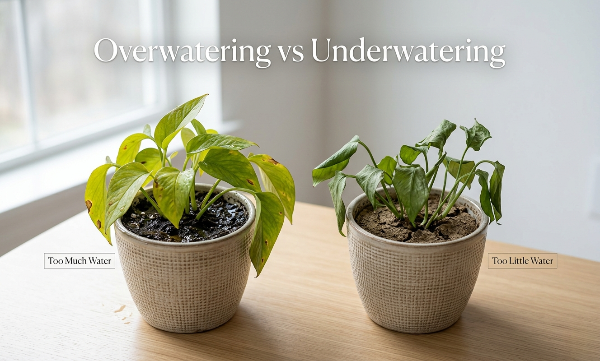
Understanding Overwatering vs Underwatering: The Science
Before we look at symptoms, let’s understand what’s actually happening to your plant in each scenario. This knowledge makes diagnosis much easier.
- What Happens When You Underwater: Plant roots absorb water from the soil. When the soil dries out completely, there’s no water available for the roots to take up. Cells throughout the plant lose turgor pressure (the water pressure that keeps them rigid), causing wilting. The plant prioritizes survival, so it drops older leaves first to conserve water for new growth. It’s straightforward: no water in soil equals no water in plant.
- What Happens When You Overwater: This one’s less intuitive. Roots need oxygen to function, and they get it from air pockets in the soil. When soil stays constantly wet, water fills those air pockets. Roots suffocate, then rot. Dead roots can’t absorb water, even though the plant is literally sitting in water. The plant wilts from dehydration despite soggy soil. This is why overwatering vs underwatering looks so similar at first glance.
Understanding this difference is key: underwatering is a supply problem (no water available), while overwatering is a function problem (water available but roots too damaged to use it).
Visual Comparison: Overwatering vs Underwatering Symptoms
The best way to distinguish overwatering vs underwatering is comparing symptoms side by side. Here’s a complete breakdown:
| Symptom Category | Overwatering | Underwatering |
|---|---|---|
| Leaf Texture | Soft, mushy, limp | Crispy, dry, papery |
| Yellowing Pattern | Starts at lower/older leaves, moves upward | Starts at leaf tips and edges, moves inward |
| Brown Spots | Wet, dark brown or black patches | Dry, crispy, tan or light brown edges |
| Wilting Type | Leaves droop but feel swollen with water | Entire plant droops, leaves curl inward |
| Leaf Drop | Green leaves fall off easily when touched | Leaves turn completely brown before falling |
| New Growth | Yellow, pale, or stunted | Normal color but smaller than usual |
| Soil Condition | Stays wet 4+ days after watering | Dry, pulls away from pot edges |
| Soil Smell | Sour, musty, or rotten odor | Normal earthy smell or no smell |
| Root Color | Brown, black, or gray | White, tan, or light brown |
| Root Texture | Slimy, mushy, fall apart easily | Firm but dry, possibly brittle |
| Stem Base | Soft, mushy, dark patches | Firm but wilted, normal color |
| Mold/Fungus | White mold on soil surface, algae growth | No mold present |
| Recovery Time After Watering | No improvement or gets worse | Perks up within 6-12 hours |
| Pot Weight | Heavy, even days after watering | Very light when lifted |
| Drainage | Water pools on surface, drains slowly | Water drains through quickly |
This table is your diagnostic checklist. When you suspect a watering problem, work through these categories one by one. Most cases show clear patterns in 5-6 categories, making the diagnosis obvious.
The Three Tests That Never Lie
Forget guessing. These three physical tests tell you exactly what you’re dealing with when comparing overwatering vs underwatering.
Test 1: The Finger Test
This is your primary diagnostic tool. Stick your index finger into the soil up to your second knuckle, about 2 inches (5 cm) deep. What you feel determines everything:
- Wet and muddy: Soil clings to your finger like paste. Water may squeeze out when you press. This indicates overwatering.
- Damp but not wet: Soil feels cool and slightly moist but doesn’t stick heavily. This is perfect moisture.
- Dry and dusty: Soil is powder-dry and falls off your finger immediately. This signals underwatering.
For deep pots over 10 inches (25 cm), use a wooden chopstick or bamboo skewer. Insert it to the bottom, leave it for one minute, then pull it out. Wet soil will cling to the bottom portion, showing you moisture levels throughout the root zone.
Test 2: The Weight Test
Lift your plant immediately after a thorough watering. Notice how heavy the pot feels. Now lift it 3-4 days later. A properly watered pot should feel significantly lighter as the plant drinks and water evaporates.
If the pot feels just as heavy as watering day after 5-7 days, you have an overwatering problem. The soil is retaining too much moisture. If the pot feels feather-light just 2-3 days after watering, you may have an underwatering issue or extremely fast-draining soil.
Test 3: The Recovery Test
Water your wilting plant and observe for 24 hours:
Underwatered plant response:
- Leaves perk up within 2-8 hours
- Wilting reverses dramatically
- Plant looks nearly normal by the next morning
- No new damage appears
Overwatered plant response:
- Plant stays wilted or wilts more
- No improvement in leaf firmness
- Additional yellowing appears within 2-3 days
- Soil stays soggy for 5+ days
This test is particularly useful when visual symptoms alone don’t give you a clear answer on overwatering vs underwatering.
Read More: How to treat root rot
Checking Your Roots: The Final Verdict
When you’re still unsure about overwatering vs underwatering after the tests above, examining the roots gives you definitive proof. Gently remove the plant from its pot and look at the root ball.
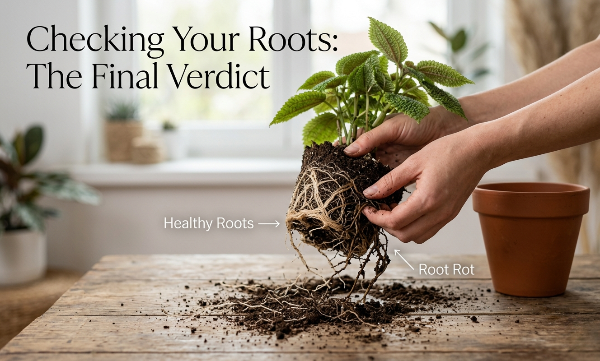
Healthy roots (underwatering or proper watering):
- White, cream, or light tan color
- Firm to the touch
- Intact structure, they don’t fall apart
- Fresh, earthy smell
- Multiple visible root tips
Rotted roots (overwatering):
- Brown, black, or dark gray color
- Mushy, slimy texture
- Fall apart when touched
- Foul, sewage-like smell
- Fewer roots than pot size should have
- Root tips are dead or missing
You don’t need to unpot your plant for every diagnosis, but if all other signs are unclear and the plant isn’t responding to treatment, a root check provides absolute certainty about overwatering vs underwatering.
Common Mistakes That Confuse the Diagnosis
Even with all the information above, people still misdiagnose overwatering vs underwatering. Here’s why:
- Mistake 1: Trusting the Top Inch Only
- The soil surface can be bone dry while 3 inches down it’s still wet from overwatering. Always check deeper, especially in large pots with dense soil mixes.
- Mistake 2: Watering on a Schedule
- “Every Sunday at 10 AM” works until it doesn’t. Seasonal changes, pot size, soil type, and plant growth all affect water needs. A schedule that prevents underwatering in summer causes overwatering in winter.
- Mistake 3: Assuming Wilting Always Means Thirsty
- This is the biggest error. Wilting is a symptom of stress, not specifically a lack of water. Overwatered plants wilt because rotted roots can’t function. Check the soil first, always.
- Mistake 4: Using Cheap Moisture Meters
- Those $5 moisture meters from the hardware store give wildly inaccurate readings. They rust, malfunction in different soil types, and often show “dry” when soil is actually wet, or vice versa. Your finger is more accurate.
- Mistake 5: Ignoring Drainage
- You can have perfect watering habits, but if your pot has no drainage holes, you’re setting up an overwatering situation. Water accumulates at the bottom with no escape route. Always use pots with drainage.
- Mistake 6: Seasonal Blindness
- Your plant needs 50-70% less water in winter compared to summer in most homes. Indoor heating reduces humidity but also slows plant growth dramatically. Continuing your summer watering routine into November is a common cause of winter overwatering.
Read More: snake plant watering tips
How to Fix Overwatering
If your diagnosis confirms overwatering, act quickly. Root rot progresses fast once it starts.
Immediate Steps:
- Stop watering completely. Don’t add a single drop until soil is nearly dry.
- Remove the plant from its pot and inspect roots.
- Cut away all brown, mushy, or slimy roots with clean scissors. Be aggressive. Only white or tan firm roots should remain.
- If more than 70% of roots are rotted, the plant may not survive. Take healthy stem cuttings as backup.
- Repot in completely fresh, dry potting mix. Never reuse the old soil.
- Choose a pot with multiple drainage holes.
- Water lightly after repotting, just enough to settle soil around roots.
- Place in bright indirect light and wait. Don’t water again until the soil is dry 2 inches deep.
Going Forward:
- Reduce watering frequency by at least 30-50%
- Always check soil before watering
- Ensure proper drainage in all pots
- Use well-draining potting mix with perlite or bark added
- Consider terracotta pots which dry faster than plastic
Recovery from overwatering takes weeks to months. Be patient and resist the urge to water frequently.
How to Fix Underwatering
Fixing underwatering is simpler and faster than overwatering, but there are still right and wrong ways.
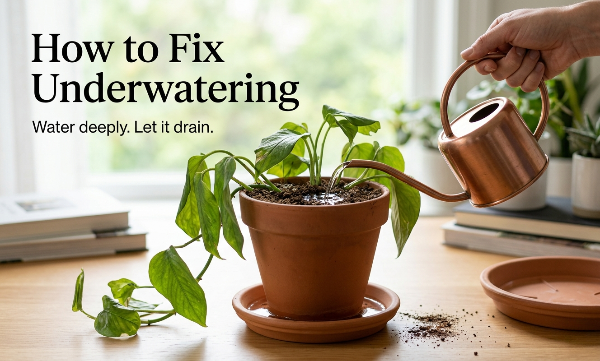
Immediate Steps:
- Water thoroughly until water runs freely from drainage holes. Don’t stop at the first sign of water, keep going for 10-15 seconds.
- If water runs straight through without being absorbed (hydrophobic soil), use the bottom-watering method: place the pot in a tray of water for 20-30 minutes.
- Let excess water drain completely before returning the plant to its decorative pot.
- Within 6-12 hours, you should see improvement in leaf firmness and wilting.
Going Forward:
- Check soil moisture every 2-3 days instead of weekly
- Water when the top 1-2 inches (2.5-5 cm) feel dry
- Group plants together to increase ambient humidity
- Consider self-watering pots if you travel frequently
- Mulch the soil surface with bark to slow evaporation
- Move the plant to slightly lower light if soil dries out every day
Brown, crispy leaves won’t recover, but new growth should appear healthy within 1-2 weeks.
Plant-Specific Considerations for Overwatering vs Underwatering
Different plant types have different tolerances:
Succulents and Cacti: Nearly impossible to underwater, extremely easy to overwater. When in doubt, don’t water. They can go 4-8 weeks without water and be fine.
Ferns and Calatheas: These moisture lovers show underwatering symptoms quickly. They want consistently moist (not wet) soil. Check them more frequently.
Snake Plants and ZZ Plants: Drought-tolerant to the extreme. 90% of the time, if these plants are dying, it’s from overwatering, not underwatering.
Pothos and Philodendrons: Fairly balanced. They tolerate both brief drought and occasional overwatering, but consistent extremes in either direction cause problems.
Fiddle Leaf Figs and Monsteras: Sensitive to overwatering. They prefer soil to dry out significantly between waterings. Err on the side of underwatering.
Knowing your specific plant’s water preferences helps you interpret overwatering vs underwatering symptoms more accurately.
FAQs
What is the difference between overwatering and underwatering?
Overwatering means the soil stays constantly wet, causing roots to rot from lack of oxygen. Underwatering means the soil dries out completely and roots cannot absorb water. Both cause wilting, but overwatered plants have mushy leaves and wet soil, while underwatered plants have crispy leaves and dry soil.
How can you tell if a plant is overwatered or underwatered?
Check the soil moisture first by inserting your finger 2 inches deep. Wet, muddy soil indicates overwatering. Bone-dry, dusty soil indicates underwatering. Also examine leaf texture: soft and mushy suggests overwatering, while crispy and dry suggests underwatering.
Can a plant recover from overwatering?
Yes, if caught early before extensive root rot develops. Remove the plant from wet soil, cut away rotted roots, repot in fresh dry mix, and drastically reduce watering frequency. If more than 70% of roots are dead, recovery is unlikely.
Is it worse to overwater or underwater a plant?
Overwatering is generally worse because it causes root rot, which can be fatal and difficult to reverse. Underwatering causes temporary stress that reverses quickly once you water. Most plants recover faster from underwatering than overwatering.
What does overwatering look like compared to underwatering?
Overwatering shows soft yellow leaves starting from the bottom, mushy stems, wet soil for days, and often mold on the soil surface. Underwatering shows crispy brown leaf edges, dry curled leaves, bone-dry soil that pulls from the pot, and the plant perks up immediately after watering.
How do you fix an overwatered plant?
Stop watering immediately, remove the plant from its pot, cut away all brown rotted roots, repot in fresh dry potting mix with good drainage, and wait at least one week before watering again. Going forward, water only when soil is dry 2 inches deep.
Why does my plant look underwatered even though the soil is wet?
This is classic overwatering. When roots rot from sitting in waterlogged soil, they can’t absorb water even though it’s available. The plant shows dehydration symptoms (wilting, drooping) despite wet soil. Check the roots; they’re likely brown and mushy from rot.
How often should I water to avoid overwatering vs underwatering?
There’s no universal schedule. Water frequency depends on plant type, pot size, soil mix, light levels, humidity, and season. Instead of a schedule, water when the top 1-2 inches of soil feel dry. This might be every 3 days in summer or every 14 days in winter for the same plant.
The Key to Diagnosing Overwatering vs Underwatering
After growing hundreds of plants through every possible watering mistake, here’s what I’ve learned: the answer is always in the soil, not the leaves. Leaves show you that something is wrong. The soil tells you what’s wrong.
When you see yellow leaves or wilting, resist the immediate urge to water or not water. Take 30 seconds to stick your finger in the soil. Feel the texture. Notice the weight of the pot. Look at the drainage. These physical checks give you concrete data instead of guesses.
The comparison between overwatering vs underwatering becomes obvious once you train yourself to check soil first and leaves second. Most people do it backward, which leads to misdiagnosis and dead plants.
Remember: you can fix underwatering in one watering session. Overwatering requires weeks or months of recovery, if the plant survives at all. When in doubt between the two, it’s always safer to wait another day before watering.
Your plants are more resilient than you think, but they need you to understand what they’re actually experiencing underground. Master the diagnosis of overwatering vs underwatering, and you’ve solved 80% of houseplant problems before they become fatal.
1 thought on “Overwatering vs Underwatering: How to Tell”