
The first Calathea I brought home sat in my bedroom for exactly three days before the leaf tips turned brown and crispy. I’d watered it properly, it had decent light, and I had no idea what I was doing wrong. Within two weeks, half the leaves had browning edges that made the plant look diseased. I moved it to the bathroom, misted it daily, and suddenly it thrived. That’s when I realized that Calathea isn’t actually that difficult, it’s just different from every other houseplant.
After growing eight different Calathea varieties over the past four years and talking to collectors who’ve kept single plants alive for a decade, I’ve figured out what makes this plant tick. The secret isn’t one single thing. It’s understanding that Calathea plants are jungle understory plants that evolved in constant moisture and humidity, and they’ll tell you immediately if you get the environment wrong. But here’s the good news: once you understand what they actually need, they become easier than a lot of people claim.
| Aspect | Details |
|---|---|
| Botanical Name | Calathea spp. (genus includes 60+ species) |
| Common Names | Calathea, Prayer Plant, Cathedral Windows, Peacock Plant, Zebra Plant, Rattlesnake Plant |
| Plant Family | Marantaceae (includes Maranta, Stromanthe, Ctenanthe) |
| Native Region | Rainforests of Central and South America, West Africa |
| Light | Medium to bright indirect light (no direct sun) |
| Water | Keep soil consistently moist (not soggy), reduce in winter |
| Humidity | 50-70% minimum (high humidity essential) |
| Temperature | 65-80 degrees F (18-27 degrees C), never below 60°F |
| Soil | Well-draining peat-based mix with perlite (2:1 ratio) |
| Mature Size | 1-3 feet tall (30-90 cm) depending on variety |
| Growth Rate | Moderate to fast with proper humidity and light |
| Toxicity | Non-toxic to cats and dogs (ASPCA confirmed safe) |
| Difficulty Level | Intermediate (humidity and watering requirements) |
| Special Feature | Leaves fold up at night (nyctinasty – responds to light) |
What’s Actually Happening With Your Calathea’s Leaves
Here’s something mind-blowing that most plant guides bury: your Calathea’s leaves literally move throughout the day. At night, they fold upward like hands in prayer. In the morning, they flatten out again. This isn’t a quirk, it’s the plant’s way of collecting dew in its native rainforest habitat and adjusting its surface area to capture sunlight efficiently.
This leaf movement (called nyctinasty if you want to sound smart at parties) is why the plant got the common name “Prayer Plant.” But here’s the key insight that changed how I care for mine: this leaf movement is also the plant telling you when conditions are wrong. If the leaves are constantly curled up tight even during the day, the humidity is too low or the plant is stressed.
The Calathea name is sometimes confused with Maranta, which is the true prayer plant. They’re cousins in the Marantaceae family and share almost identical care requirements, so if you see advice for Maranta, it applies to Calathea too. The difference is subtle: Maranta leaves are typically more delicate and the plant stays smaller, while many Calathea varieties have larger, showier leaves with bold patterns.
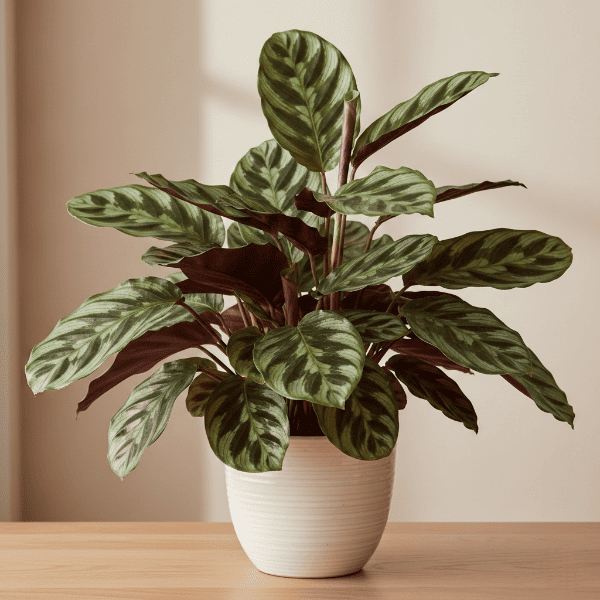
Light: The Goldilocks Requirement (Not Too Bright, Not Too Dark)
Calathea plants hate direct sunlight. I can’t stress this enough because it’s one of the few care mistakes you can’t undo. One afternoon of harsh direct sun through a west-facing window turned my Calathea orbifolia’s leaves from green to brown-edged mush in about six hours.
What they actually want is medium to bright indirect light. Think of the light that filters through sheer curtains, or the dappled light under tree branches. A north-facing window is perfect. An east-facing window works great. A west-facing window can work but place the plant several feet back from the window so the afternoon sun doesn’t reach it directly.
The tricky part: Calathea can survive in lower light than most plants. I’ve successfully grown these in bathrooms with no natural light source except what comes through a frosted window. But low light Calathea won’t thrive, they stay small, don’t produce new leaves regularly, and the foliage patterns look muted instead of vibrant.
My bathroom setup actually works better than my bedroom setup because of the humidity, even with less light. So if you have a bright, humid bathroom, that’s genuinely one of the best places for a Calathea.
Pro tip: Rotate your plant a quarter turn every week. Mine was leaning toward the window until I started rotating it, and now it grows evenly in all directions.
Humidity: Why Your Calathea’s Leaves Are Crispy
Brown leaf tips on Calathea are like a check-engine light for humidity. Low humidity causes this specific symptom and nothing else fixes it besides raising moisture levels. I’ve seen people water their Calathea perfectly, provide good light, and still watch it develop brown edges because the air was too dry.
These plants evolved in rainforests where humidity routinely sits at 70-90%. Your home’s humidity is probably 30-50%, especially in winter with heating running. Calathea tolerates 50% humidity, but really thrives at 60-70%.
The best solution is a humidifier. I use a small ultrasonic one near my plant shelf running 8-10 hours a day, and I’ve solved 95% of my browning-leaf problems. Second best is grouping plants together (they create a micro-humid zone), or placing the pot on a pebble tray with water underneath. Fill the tray with pebbles, add water, and rest the pot on the pebbles so the pot isn’t touching water directly (this prevents root rot).
Daily misting helps but doesn’t solve the problem. Misting temporarily raises humidity but it evaporates within minutes. I still mist mine daily because it feels good for the plant, but it’s more for foliar cleansing than serious humidity boost.
Here’s something crucial: use filtered or distilled water for misting and watering. Chlorine and minerals in tap water accumulate on leaves and cause brown spots that look like damage but are actually chemical burns. After I switched to filtered water, my leaf spotting issues basically disappeared.
Read more: humidity concerns and how to fix them properly
Watering: The Consistency Game (Not About Frequency)
This is where Calathea gets a reputation for being finicky, and honestly, it’s kind of fair. But the issue isn’t that the plant is difficult, it’s that people approach watering incorrectly.
Don’t water on a schedule. Don’t say “I water Wednesdays.” Your Calathea doesn’t care what day it is. It only cares about soil moisture.
The goal is to keep the soil consistently moist but not waterlogged. Stick your finger into the soil up to the first knuckle. If it feels wet, don’t water. If it feels dry at that depth, water thoroughly until water runs out the drainage holes, then empty the saucer so the plant isn’t sitting in standing water.
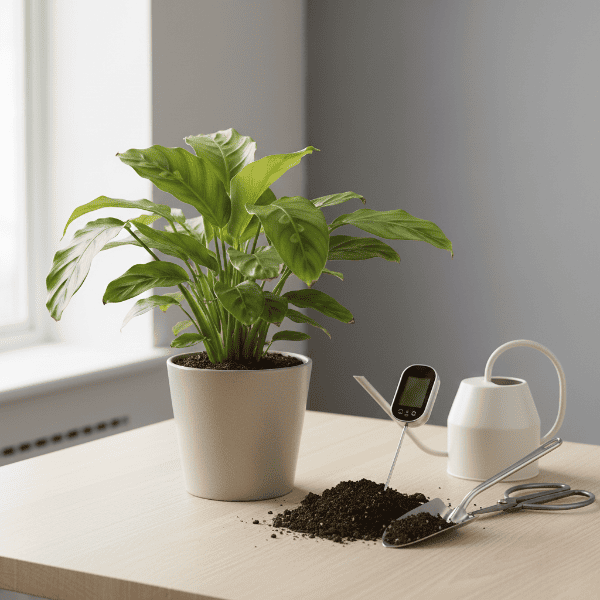
In spring and summer (active growing season), this usually means watering every 4-6 days depending on your home’s temperature and humidity. In fall and winter, reduce to every 7-10 days. The soil should dry out slightly more between waterings in winter, but never completely.
Here’s what kills most Calathea: overwatering combined with poor drainage. If your soil stays soggy for days, the roots suffocate. They start to rot. The plant develops yellow leaves and that sickly sweet smell of root rot. This is why soil choice matters so much.
Read more: Overwatering vs underwatering
Soil and Potting: Why Standard Potting Mix Fails
Regular potting soil is too dense for Calathea. It holds moisture and compacts over time, which leads to the root rot scenario I just mentioned.
Calathea needs a light, airy, well-draining mix. Mix your own: 2 parts peat-based potting mix to 1 part perlite. Some growers add orchid bark chunks for extra drainage. The mix should feel fluffy and light, never dense.
The pot itself matters. Use a container with multiple drainage holes. I prefer terracotta or plastic pots with good drainage. Repot every 1-2 years in spring before the growing season starts. When repotting, use a pot only 1-2 inches larger than the current pot. Calathea doesn’t need tons of extra space. Root-bound plants actually flower better than ones with excess soil.
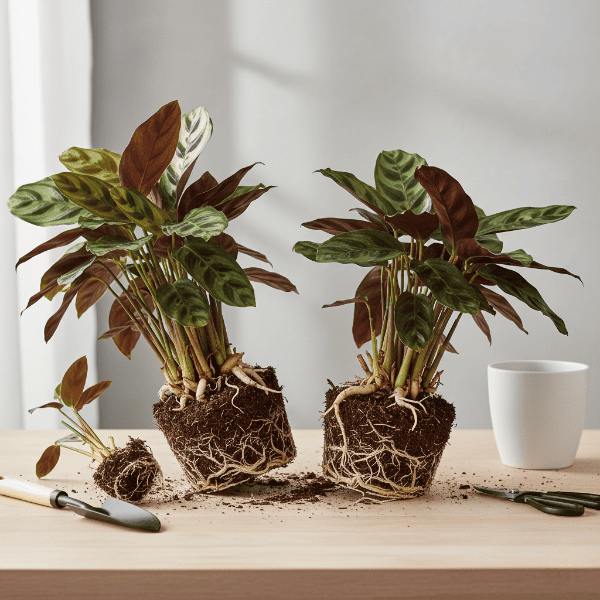
Pro tip: Calathea can’t propagate from regular stem cuttings. The only way to multiply your plant is by division. In spring when you repot, you can carefully separate clumps if the plant has multiple growth points. Each division should have a few stems and healthy roots. This is actually how I’ve expanded my Calathea collection without buying new plants.
Temperature: Why Cold Windows Kill Calathea
Calathea is tropical through and through. It needs consistent warmth. Optimal temperature range is 65-80 degrees F (18-27 degrees C). Never expose it to temperatures below 60°F for extended periods.
This matters way more than people realize. Keep your Calathea away from cold windows in winter, air conditioning vents in summer, and anywhere with sudden temperature swings. I killed a plant by placing it near a window that got cold air drafted in every time someone opened the door.
Drafts are actually worse than just cold. They suck moisture out of the air instantly, tanking your humidity while also stressing the plant. If you want to place a Calathea near a window, make sure it’s not near any air leaks or heating/cooling vents.
Read more: best plants for bedroom
Fertilizing: The Light Touch Approach
During spring and summer (active growing season), feed your Calathea monthly with a diluted balanced houseplant fertilizer. Use half the recommended strength. High-nitrogen formulas encourage leafy growth but won’t help. Look for something like 5-5-5 or 10-10-10.
From fall through winter, stop fertilizing completely. This rest period helps the plant reset for spring growth.
Fun fact: over-fertilizing causes a salt buildup in the soil that burns roots and creates brown leaf tips that look like a humidity problem but actually aren’t. If you see browning and you know your humidity is good, try flushing the soil with distilled water to clear any salt buildup.
Pruning and Maintenance: Keeping It Full and Healthy
Calathea doesn’t need pruning the way some plants do, but you should remove dead or damaged leaves. Old leaves naturally yellow and should drop on their own. If a leaf is 50% brown or damaged, remove it to direct energy toward healthy growth.
One thing I do: regularly wipe the leaves with a soft, damp cloth. The big, glossy leaves of many Calathea varieties collect dust. Cleaning them improves light absorption and makes the patterns pop visually. Use only distilled water no commercial leaf shine products.
Common Problems and Exact Fixes
- Brown leaf tips: This is 90% of Calathea problems. Low humidity. Raise humidity with a humidifier. If humidity is already high, check if you’re using tap water (mineral buildup causes browning). Switch to filtered water.
- Yellow leaves: Overwatering or root rot. Let soil dry out between waterings. Check if pot has drainage holes. Repot to fresh soil if you suspect root rot.
- Curled leaves during the day: Low humidity or the plant is thirsty. Check soil if top inch is dry, water thoroughly. Increase humidity with misting or humidifier.
- Leaf spot (brown spots on leaves): Fungal issue from wet leaves or poor air circulation. Don’t mist the leaves at night when they’ll stay wet. Provide air circulation with a small fan nearby.
- Stunted growth: Too little light or plant is root-bound. Move to brighter location or repot to fresh soil.
- Spider mites: Look on undersides of leaves for fine webbing. These pests love warm, dry air. Increase humidity and spray with insecticidal soap every 3 days for two weeks.
Read more: How to Get Rid of Spider Mites on Indoor Plants
Varieties Worth Growing
- Calathea orbifolia (Round-Leaf Calathea): Large, round leaves with silver markings. This is the dramatic one. Needs bright indirect light but worth the effort.
- Calathea roseopicta (Rose-Painted Calathea): Deep pink to burgundy tones on the leaf undersides. One of my favorites for visual impact.
- Calathea makoya (Peacock Plant): Striking pattern with eye-shaped markings. Smaller growing than some varieties.
- Calathea lancifolia (Rattlesnake Plant): Narrow, lance-shaped leaves with wavy edges. Slightly more forgiving than some other varieties.
- Calathea ornata (Pinstripe Plant): Thin pink or white stripes on dark green leaves. Vigorous grower if humidity is high.
All varieties share the same basic care requirements, so pick based on which pattern appeals to you visually.
5 Mistakes That Doom Calathea Plants
- Mistake 1: Placing it in direct sunlight. One afternoon of harsh rays and your leaves are permanently damaged. Move it back from windows or use sheer curtains.
- Mistake 2: Using tap water. Minerals accumulate and cause brown spotting that looks like disease but is actually chemical damage. Always use filtered or distilled water.
- Mistake 3: Ignoring humidity completely. You can’t ignore this. It’s not optional. Get a humidifier or your plant will have permanently brown edges.
- Mistake 4: Repotting in standard potting soil. That dense, moisture-holding soil will cause root rot. Mix your own with perlite added.
- Mistake 5: Watering on a schedule instead of checking soil. “Every Thursday” doesn’t work. Check the soil. Water when the top inch is dry. That’s it.
Should You Get a Calathea?
Let me be real: if you want a plant that survives neglect, this isn’t it. If you travel frequently or forget to water things, pick something else.
But if you have a humid space (like a bathroom or kitchen), can check soil moisture consistently, and appreciate beautiful foliage, Calathea is absolutely worth growing. These plants are long-lived I’ve heard of people keeping the same plant for 20 years. The leaf patterns are genuinely stunning. And they’re safe for cats and dogs, which matters if you have pets.
Once you understand that it’s really just about humidity and consistent moisture, the plant becomes easier. You’re not fighting its nature you’re recreating its nature. That’s the whole secret.
Frequently Asked Questions
Why are my Calathea leaves brown at the tips?
Low humidity is the most common cause. Raise humidity with a humidifier, misting, or pebble tray. If humidity is already high, you might be using tap water with minerals. Switch to filtered water.
Can I propagate Calathea from cuttings?
No. Calathea can only be propagated by division. Wait until spring, repot the plant, and carefully separate clumps if there are multiple growth points.
What temperature is too cold for Calathea?
Never let it drop below 60°F (15°C) for extended periods. Anything below 55°F will damage the leaves. Keep it away from cold windows and drafts.
Is Calathea toxic to cats or dogs?
No. According to ASPCA resources, Calathea is completely non-toxic to both cats and dogs. It’s safe for pet-friendly homes.
Why do the leaves move at night?
This movement (nyctinasty) is the plant’s natural response to light changes. The leaves fold up to collect dew and position themselves to capture morning sunlight. It’s completely normal and healthy.
How often should I water my Calathea?
Don’t follow a schedule. Water when the top 1 inch of soil feels dry, which is usually every 4-6 days in summer and 7-10 days in winter. Always use filtered water.
Can Calathea grow in low light?
It can survive in low light but won’t thrive. Leaves will stay small, colors will be muted, and growth will be minimal. Medium to bright indirect light is ideal.
Why won’t my Calathea get bigger?
Usually insufficient light or the plant is root-bound. Move it to a brighter location or repot to fresh soil. Also make sure humidity is high, low humidity stunts growth.
Is Calathea harder than other houseplants?
It’s more particular about humidity and watering consistency than tougher plants like pothos or snake plant. But it’s not harder if you understand its needs. It just requires different care.