
Snake plant care is refreshingly easy, which is exactly why this plant has earned its reputation as one of the most beginner-friendly houseplants around. Give it well-draining soil, let it dry out between waterings, and place it in indirect light, and you’ve got yourself a happy snake plant. I’ve been growing Sansevieria for over seven years now, and I keep coming back to it because it handles neglect like a champ. Whether you just picked one up from Home Depot or you’re trying to revive a sad-looking one in the corner of your office, this guide covers everything you need to keep your snake plant thriving.
| Aspect | Details |
|---|---|
| Botanical Name | Dracaena trifasciata (formerly Sansevieria trifasciata) |
| Common Names | Snake Plant, Mother-in-Law’s Tongue, Viper’s Bowstring Hemp, Saint George’s Sword |
| Plant Family | Asparagaceae |
| Native Region | West Africa (Nigeria, Congo) |
| Light | Low to bright indirect light, tolerates some direct morning sun |
| Water | Every 10-14 days in summer, every 21-30 days in winter |
| Humidity | 30-50% – average household humidity is perfectly fine |
| Temperature | 60-85°F (15-29°C) |
| Soil | Well-draining mix: 2 parts potting soil + 1 part perlite + 1 part coarse sand |
| Mature Size | 1-4 feet tall (30-120 cm) indoors, depending on variety |
| Growth Rate | Slow to moderate |
| Toxicity | Toxic to cats and dogs (ASPCA). Mildly toxic to humans if ingested. |
| Difficulty Level | Beginner-Friendly |
| USDA Zones | 9-12 (outdoors); grown as a houseplant everywhere else |
What Makes the Snake Plant So Popular?
The snake plant isn’t just another pretty face in the houseplant world, it’s a legitimate survivor. This plant has adapted to thrive in some of the harshest conditions in West Africa, and that toughness translates beautifully to indoor living.
What I love about this plant is its architectural look. Those tall, stiff, upright leaves with their striking green and yellow variegation add instant style to any room. I have one in my bedroom, one in my living room, and one in my bathroom, each one doing just fine with completely different light conditions.
And let’s talk about the air-purifying angle. NASA’s Clean Air Study found that snake plants remove toxins like formaldehyde and benzene from the air, improving indoor air quality. If you want to build a collection specifically for cleaner air, our guide on best air purifying plants covers 12 top-rated options with care details for each.
Pro tip: If you’re brand new to houseplants, start with a snake plant care. Seriously. It’s the one plant that actually thrives on a bit of neglect, making it perfect for building your confidence before moving on to fussier plants like fiddle leaf figs.
Snake Plant Care: Light Requirements
Here’s one of the biggest reasons snake plants are so popular, they’re incredibly flexible when it comes to light. I’ve grown them in a bright south-facing window and in a dim hallway, and both plants survived just fine.
That said, there’s a difference between surviving and thriving.
Ideal light: Bright, indirect light for 6-8 hours a day. An east-facing or north-facing window works perfectly. This is where your snake plant will grow the fastest and show off the best leaf color.
Tolerates: Low light conditions, including offices with only fluorescent lighting. The plant won’t grow much, but it’ll hold its own.
Avoid: Intense, direct afternoon sun for extended periods. While snake plants can handle some morning sun, harsh afternoon rays (especially through a south- or west-facing window in summer) can scorch the leaves, leaving brown, crispy patches.
In my experience, the varieties with more yellow variegation, like the classic Sansevieria trifasciata ‘Laurentii’, need slightly brighter light to maintain their color. In too little light, they tend to revert toward solid green.
If you’re growing your snake plant care in a room with very little natural light, consider supplementing with a grow light. Even a basic LED grow light running for 10-12 hours daily can make a significant difference. Check out our guide on best grow lights for indoor plants for some solid options.
How to Water Your Snake Plant (Without Killing It)
If there’s one thing that kills more snake plants than anything else, it’s overwatering. These plants store water in their thick, fleshy leaves, which means they can go weeks without a drink. Drowning them in water is a fast track to root rot.
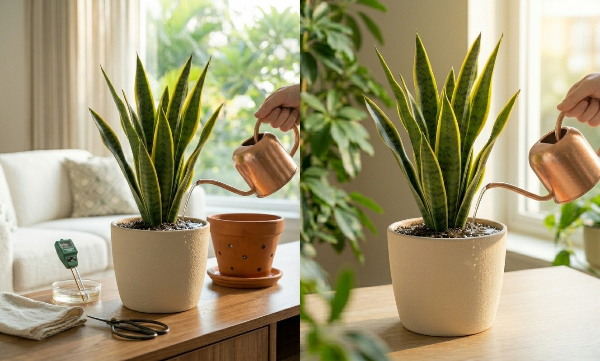
The golden rule: Let the soil dry out completely between waterings. Stick your finger about 2 inches (5 cm) into the soil. If it’s dry, water it. If there’s any moisture at all, wait a few more days.
Seasonal Watering Schedule
- Spring/Summer (growing season): Water every 2–4 weeks, allowing the soil to dry out completely between sessions. For a full seasonal watering schedule and common watering mistakes, read our dedicated snake plant watering guide.
- Fall/Winter (dormant season): Water every 21-30 days. Growth slows down dramatically, and wet soil in cold conditions is a recipe for disaster.
How to Water Properly
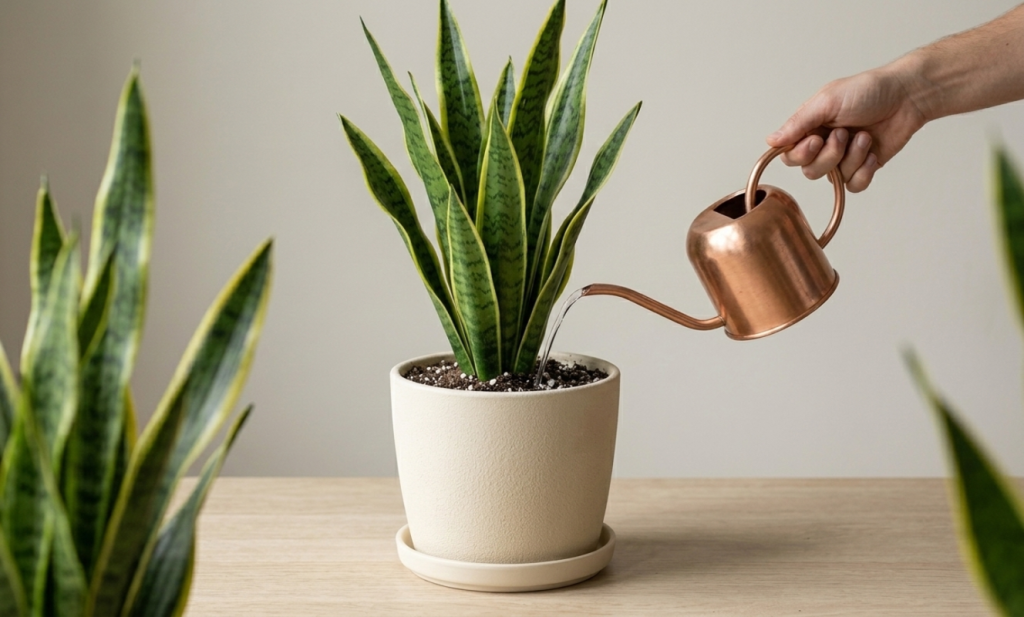
I’ve found that the bottom-watering method works incredibly well for snake plants. Place the pot in a tray of water for 15-20 minutes and let the soil soak it up from below. This encourages deep root growth and avoids getting water trapped between those tightly packed leaves.
If you top-water instead, pour slowly and evenly around the base of the plant. Make sure all excess water drains out of the bottom. Never let your snake plant care sit in standing water.
Pro tip: In the dry winter months when central heating reduces indoor humidity, you might think your plant needs more water. It doesn’t. The cooler temperatures mean slower growth and less water uptake. I’ve gone a full month without watering mine in January, and it looked perfectly happy.
A moisture meter (about $10 at Home Depot or Amazon) takes the guesswork out entirely. Aim to water when the meter reads “dry” at the root level. Getting the watering right is the single most important part of snake plant care, so take your time to learn your plant’s rhythm.
Best Soil for Snake Plants
Snake plants demand one thing from their soil: drainage. These are semi-succulent plants with roots that will rot quickly if they sit in soggy soil.
My go-to snake plant soil mix:
- 2 parts standard potting soil (like Miracle-Gro Indoor Potting Mix)
- 1 part perlite
- 1 part coarse sand or pumice
This mix holds just enough moisture for the roots to drink while letting excess water drain away fast. I’ve tested several methods over the years, and this ratio has given me the best results across all my snake plant varieties.
Pre-made alternatives: If you don’t want to mix your own, a cactus and succulent potting mix works great right out of the bag. Espoma Organic Cactus Mix and FoxFarm Ocean Forest are both excellent choices available at most garden centers and on Amazon.
Avoid: Standard potting soil on its own. It holds too much moisture and stays wet for too long. If you’ve been using straight potting soil and your snake plant care looks fine, it’s only a matter of time before you start seeing signs of overwatering or root rot.
The trick is thinking like a desert plant parent. These plants evolved in rocky, sandy, fast-draining soils in West Africa, so mimic that in your pot.
Repotting Your Snake Plant
Snake plants are actually quite happy being slightly root-bound, so don’t rush to repot. I typically repot mine every 2-3 years, or when I see roots poking out of the drainage holes.
When to Repot
- Roots are circling the bottom or poking through drainage holes
- The plant has become top-heavy and tips over easily
- Water runs straight through the pot without being absorbed
- You see pups (baby plants) crowding the pot and pushing against the sides
How to Repot (Step by Step)
- Choose a pot only 1-2 inches (2.5-5 cm) wider than the current one. Going too big means excess soil that stays wet too long.
- Use a pot with drainage holes;, this is non-negotiable for snake plants.
- Add a layer of your well-draining soil mix to the bottom.
- Gently remove the plant from its old pot. If it’s stuck, run a knife around the inside edge.
- Shake off the old soil and inspect the roots. Trim any brown or mushy roots with clean scissors.
- Place the plant in the new pot at the same depth it was before. Don’t bury the leaves.
- Fill around the sides with fresh soil mix. Press gently to eliminate air pockets.
- Wait 3-5 days before watering to let any damaged roots heal.
Best time to repot: Spring or early summer, when the plant is entering its active growth phase. Avoid repotting in fall or winter, the plant won’t establish well during dormancy.
Pro tip: Terracotta pots are ideal for snake plants. They’re porous, which means they wick excess moisture away from the soil. Plastic pots work too, but you’ll need to be extra careful not to overwater. If you’re curious about other pot options, check out our best planters for indoor plants guide.
Humidity and Temperature Needs
Great news, snake plants aren’t humidity divas. They thrive in typical household humidity levels of 30-50%, which means you don’t need a humidifier, pebble tray, or daily misting routine.
Temperature
Snake plants prefer temperatures between 60-85°F (15-29°C). They’re comfortable wherever you’re comfortable. The key thing to watch out for is cold drafts. Temperatures below 50°F (10°C) can cause serious damage, including mushy, water-soaked-looking leaves.
Keep your snake plant away from:
- Drafty windows in winter
- Exterior doors that open frequently
- Air conditioning vents are blowing cold air directly on the leaves
- Unheated rooms or garages in colder climates
If you live in USDA Zones 9-12, you can grow snake plants outdoors year-round. For everyone else, keep them inside during the colder months. I’ve seen people set their snake plants on covered patios during summer, and they absolutely love the outdoor conditions. Just bring them back inside before nighttime temperatures dip below 55°F (13°C).
Humidity
One mistake I see beginners make is misting their snake plants. Don’t do it. These plants are built for dry conditions, and excess moisture on the leaves can lead to fungal issues. Just let them do their thing in your normal room humidity.
Fertilizing Your Snake Plant
Snake plants are light feeders, so you won’t need to fertilize often. In fact, over-fertilizing is more common (and more damaging) than under-fertilizing.
When to fertilize: Only during the growing season, spring and summer. Skip fall and winter entirely.
How often: Once a month during spring and summer is plenty.
What to use: A balanced liquid fertilizer diluted to half strength. I use Schultz All Purpose Liquid Plant Food (10-15-10), but Jack’s Classic 20-20-20 or Espoma Organic Indoor Plant Food are also solid picks. You can find all of these at Lowe’s, Home Depot, or Amazon.
How to apply: Water your plant with plain water first, then apply the diluted fertilizer solution. Fertilizing dry soil can burn the roots.
After testing several methods, I’ve found that less is more with snake plants. A well-fed snake plant care doesn’t look dramatically different from an unfed one, but an overfed plant can show brown leaf tips and a white crusty buildup on the soil surface from salt accumulation.
If you notice salt buildup, flush the soil by running water through it for a few minutes, then let it drain completely.
Snake Plant Propagation Methods
One of the most satisfying things about snake plants is how easy they are to propagate. I’ve turned one plant into a dozen over the past few years using these methods. For a deep dive, check out our detailed how to propagate snake plant care guide.
Method 1: Division (Easiest and Fastest)
This is my preferred method because you get a full-sized plant immediately.
- Remove the parent plant from its pot.
- Look for natural clumps or pups (baby plants growing from the rhizome).
- Using a clean, sharp knife, separate the pup from the parent, making sure each section has its own roots.
- Plant each division in its own pot with fresh, well-draining soil.
- Wait 3-5 days, then water lightly.
Method 2: Leaf Cuttings in Water
This takes patience, we’re talking 4-8 weeks for roots to form, but it’s fun to watch.
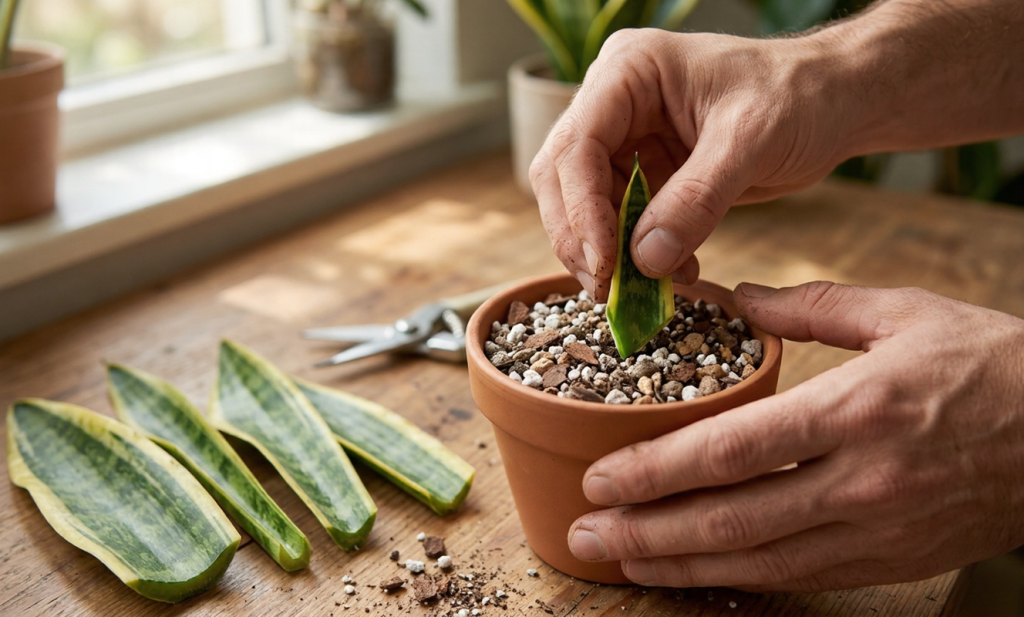
- Cut a healthy leaf near the base with a clean blade.
- Cut the leaf into 3-4 inch (7-10 cm) sections. Mark the bottom of each section (the end that was closer to the soil). This matters, cuttings planted upside down won’t root.
- Let the cut ends dry and callous over for 24-48 hours.
- Place the bottom end of each cutting into a jar of water, about 1 inch (2.5 cm) submerged.
- Change the water weekly and keep it in bright, indirect light.
- Once roots are 1-2 inches (2.5-5 cm) long, transplant into soil.
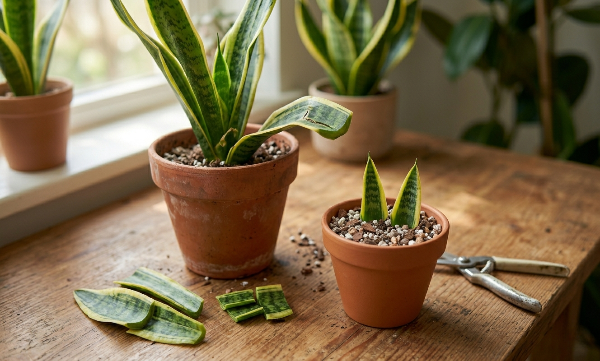
Important note: If you propagate a variegated variety (like ‘Laurentii’) through leaf cuttings, the new plant will likely lose its yellow edges and revert to solid green. Division is the only method that preserves the variegation.
Method 3: Leaf Cuttings in Soil
Same cutting process as above, but instead of water, plant the calloused cuttings directly into moist, well-draining soil about 1 inch (2.5 cm) deep. Keep the soil barely damp (not wet) and wait. Roots usually develop in 6-8 weeks.
Snake Plant Varieties Worth Collecting
One thing that surprised me when I first got into snake plants is just how many varieties exist. There are over 70 recognized species, and each one has a slightly different look. Here are some of my favorites:
| Variety | Height | Notable Features |
|---|---|---|
| ‘Laurentii’ | 2-4 ft (60-120 cm) | Classic variety with yellow leaf margins |
| ‘Black Coral’ | 2-3 ft (60-90 cm) | Dark green leaves with subtle banding |
| ‘Moonshine’ | 2 ft (60 cm) | Pale silvery-green leaves |
| ‘Cylindrica’ (African Spear) | 3-5 ft (90-150 cm) | Round, spear-shaped leaves |
| ‘Hahnii’ (Bird’s Nest) | 6-8 in (15-20 cm) | Compact rosette shape, perfect for desks |
| ‘Bantel’s Sensation’ | 2-3 ft (60-90 cm) | Thin white vertical stripes |
| ‘Whitney’ | 1-2 ft (30-60 cm) | Compact with silver-green and dark green bands |
The ‘Hahnii’ (Bird’s Nest) varieties are perfect if you’re short on space, they stay compact and look great on a desk or shelf. The ‘Cylindrica’ is a real conversation starter with its unusual round leaves.
Common Snake Plant Care Problems and Solutions
Even tough plants run into trouble sometimes. Here’s what to watch for and how to fix it.
Yellow Leaves
Cause: Almost always overwatering. The roots are sitting in wet soil and can’t breathe.
Fix: Stop watering immediately. Check the roots, if they’re mushy and brown, you’ve got root rot. Remove the plant from its pot, trim the rotten roots, let the healthy roots air-dry for a day, and repot in fresh, dry soil. Don’t water for at least a week.
Brown, Crispy Leaf Tips
Cause: Underwatering, direct sun exposure, or too much fertilizer.
Fix: Trim the brown tips with clean scissors (cut at an angle for a natural look). Adjust your watering schedule, move the plant away from direct sun, and flush the soil if you suspect fertilizer buildup.
Soft, Mushy Leaves
Cause: Root rot is caused by overwatering or poorly draining soil. If you suspect your plant has it, our guide on root rot treatment explains exactly how to diagnose the damage, trim the roots, and save the plant before it is too late.
Fix: If it’s rot, follow the root rot rescue steps above. If it’s cold damage (leaves look water-soaked), move the plant to a warmer spot and remove the damaged leaves. They won’t recover.
Leaves Falling Over or Drooping
Cause: Overwatering, root rot, insufficient light, or a pot that’s too large.
Fix: Check the roots first. If they’re healthy, the issue is likely light, move to a brighter spot. If the pot is too big, downsize to one that fits snugly around the root ball.
Leaves Curling Inward
Cause: Underwatering or pest stress (usually thrips).
Fix: Give the plant a thorough watering. If the leaves don’t uncurl within a day or two, inspect closely for tiny black or tan insects. Treat with neem oil if pests are found.
Pest Issues
Snake plants are pretty resistant to pests, but mealybugs and spider mites can occasionally show up, especially in dry indoor conditions.
Treatment: Wipe visible pests off with a cotton swab dipped in rubbing alcohol. Follow up with a neem oil spray (1 tablespoon neem oil + 1 teaspoon dish soap per quart/liter of water). Spray the entire plant every 7 days for 3 weeks.
Is the Snake Plant Pet-Safe?
Snake plants are mildly toxic to cats, dogs, and humans. If you have pets at home, read our detailed article on snake plant toxicity to cats to understand the symptoms, risk level, and how to keep your animals safe.
Now, here’s some practical perspective. The leaves are tough and fibrous, so most pets won’t chew on them enough to cause serious harm. But “probably fine” isn’t a risk worth taking, especially with curious kittens or puppies.
If you have pets, consider these options:
- Place the snake plant on a high shelf or in a room your pets can’t access
- Use a plant stand that keeps it out of reach
- Switch to pet-safe alternatives like spider plants, Boston ferns, or calathea
For more information on snake plant care toxicity, read our detailed breakdown: snake plants toxicity to cats. And if you’re looking for houseplant options that won’t worry you, our indoor plants safe for cats” guide has plenty of great picks.
Snake Plant Care Mistakes You Should Avoid
After years of growing (and occasionally killing) these plants, here are the biggest mistakes I see:
1. Overwatering
This is the number one killer, full stop. Snake plants would rather be bone-dry than slightly damp. When in doubt, don’t water. That yellow, mushy leaf? Too much water.
2. Using Pots Without Drainage Holes
It doesn’t matter how carefully you water, without drainage holes, excess water has nowhere to go and your roots will rot. Always use pots with drainage.
3. Repotting into a Pot That’s Too Large
A bigger pot means more soil. More soil means more moisture retained around the roots. Stick to going up just 1-2 inches (2.5-5 cm) in diameter when repotting.
4. Using Heavy, Moisture-Retaining Soil
Regular potting soil straight from the bag is too dense for snake plants. Always amend with perlite and sand for better drainage.
5. Placing Near Cold Drafts
Snake plants can’t handle cold. A spot near a drafty winter window or an exterior door can cause cold stress, turning leaves mushy and dark.
6. Fertilizing in Winter
The plant is dormant in winter. Fertilizing during this time leads to salt buildup and chemical burns on the roots. Fertilize only in spring and summer.
FAQ
How often should I water a snake plant?
Watering is the most critical part of snake plant care. Water every 10-14 days during spring and summer, and every 21-30 days in fall and winter. Always let the soil dry out completely between waterings. Stick your finger 2 inches (5 cm) into the soil, if it’s dry, it’s time.
Can snake plants survive in low light?
Yes, snake plants tolerate low light better than most houseplants. They’ll survive in dim corners and offices with only fluorescent lighting. However, growth will be slower and leaf color may become less vibrant compared to plants in bright, indirect light.
Are snake plants toxic to cats and dogs?
Yes. According to the ASPCA, snake plants contain saponins that are toxic to both cats and dogs. Ingestion can cause vomiting, nausea, and diarrhea. Keep the plant out of your pet’s reach or choose pet-friendly alternatives.
Why are my snake plant leaves turning yellow?
Yellow leaves are almost always caused by overwatering. Check the soil, if it’s damp, stop watering and inspect the roots for rot. Brown, mushy roots need to be trimmed before repotting in fresh, dry soil.
How do I propagate a snake plant?
The easiest method is division, separate pups from the mother plant during repotting and plant them individually. You can also propagate through leaf cuttings placed in water or soil, though this takes 4-8 weeks and variegated varieties may lose their color.
Do snake plants purify the air?
Snake plants were included in the NASA Clean Air Study for their ability to filter toxins like formaldehyde and benzene. While a single plant won’t dramatically purify a room, multiple plants can contribute to slightly better indoor air quality.
What type of pot is best for a snake plant?
Terracotta pots with drainage holes are ideal. The porous material helps wick away excess moisture, reducing the risk of overwatering. Ceramic and plastic pots work too, but require more careful watering.
How fast do snake plants grow?
Snake plants are slow to moderate growers. In optimal conditions (bright indirect light, proper watering, warm temperatures), expect 2-4 new leaves per year. Growth slows significantly in low light or during winter dormancy.
Final Thoughts
Snake plant care really comes down to three things: don’t overwater, give it decent light, and use well-draining soil. Nail those basics and your snake plant care will reward you with years of gorgeous, low-maintenance greenery.
I’ve grown dozens of houseplant species, and I always tell beginners to start with a snake plant. It teaches you patience, it’s incredibly forgiving, and it looks stunning in any space. Once you’ve got one thriving, you’ll probably want to try different varieties, and before you know it, you’re a full-blown plant parent.
If you’re looking to expand your collection, check out our guides on money tree plant care and common indoor plants for more easy-to-grow picks.
Happy planting!