
Pothos leaves turning yellow is the most common distress signal this plant sends, and the mistake most people make is treating the symptom removing yellow leaves, adding water, adding fertilizer without identifying the actual cause first. The wrong response makes things worse. Adding water to a plant that is already drowning kills more roots. Adding fertilizer to a plant with root damage burns the tissue trying to recover. The fix for pothos leaves turning yellow depends entirely on which of the eight specific causes is responsible, and each cause has a distinct visual signature that makes diagnosis possible before you touch the watering can or the fertilizer bottle. Use the rapid diagnosis table below first, then read the expanded section for whichever cause matches what you are seeing.
Rapid Diagnosis Table: Identify Your Cause in 60 Seconds
| Yellow Pattern | Soil Condition | Other Signs | Most Likely Cause |
|---|---|---|---|
| Lower leaves, slow spreading upward | Wet, stays wet | Soft stems, musty smell | Overwatering |
| All leaves, pale/washed out | Dry, crumbly | Crispy tips, lightweight pot | Underwatering |
| New growth pale yellow | Moist | Small leaves, slow growth | Insufficient light |
| Lower/older leaves only, uniform | Moist | No new growth issues | Natural aging (normal) |
| New leaves yellow, older leaves green | Moist | Visible between-vein green | Nutrient deficiency |
| Yellowing + wilting despite moist soil | Wet | Dark roots, sour smell | Root rot |
| Speckling, pale patches, tiny dots | Moist | Fine webbing, sticky residue | Pest damage |
| Tips burned, then base yellows | Moist | White crust on soil surface | Over-fertilizing |
Cause 1: Overwatering – The Most Common Reason for Pothos Leaves Turning Yellow
Overwatering is responsible for the majority of cases where pothos leaves turn yellow, and it is the most misdiagnosed because the wilting and yellowing it causes looks deceptively similar to thirst. When pothos roots sit in consistently wet soil, the oxygen in the soil is displaced by water. Roots without oxygen suffocate, lose the ability to absorb water or nutrients, and begin to decay. The plant shows yellow leaves not because it has too much water but because damaged roots can no longer deliver moisture and nutrition upward.
The yellowing typically starts on lower, older leaves and moves upward as root damage progresses. Stems may feel soft or limp rather than firm. The soil feels cold and wet days after you last watered. If you pick up the pot, it feels heavy.
Fix: Stop watering immediately. Let the soil dry out fully before watering again not just the surface, but at root depth. Push a finger 2 inches (5 cm) into the soil; if any moisture remains, wait. Remove the plant from its pot and inspect the roots. Firm, white or light-tan roots are healthy. Dark, soft, mushy roots are damaged. Trim all damaged roots cleanly, let the root ball air dry for 30 minutes, and repot into fresh well-draining mix. Adjust your watering schedule going forward pothos needs water only when the top 1 to 2 inches (2.5 to 5 cm) of soil are dry. To understand the visible differences between overwatered and underwatered pothos, our guide on overwatering vs underwatering covers every diagnostic symptom clearly.
Cause 2: Underwatering
Pothos leaves turning yellow from underwatering look different from those turning yellow from overwatering once you know what to check. The yellowing in underwatered plants is accompanied by dry, crispy edges on the affected leaves rather than the soft, limp texture of overwatered foliage. The soil is bone dry when you push a finger into it, often pulling away from the pot walls. The pot feels noticeably light when lifted. Yellow leaves from underwatering typically start at the tips and edges and progress inward, rather than the base-upward progression seen with overwatering.
Fix: Water the plant thoroughly – run water slowly through the soil until it drains freely from the drainage hole. If the soil has become so dry that it has hydrophobically repelled water (water runs straight through without being absorbed), place the pot in a basin of water for 20 to 30 minutes to allow the soil to rehydrate from the bottom before resuming top watering. For a consistent watering approach that prevents future drought stress, our full pothos plant care guide includes a monthly watering schedule.
Cause 3: Insufficient Light
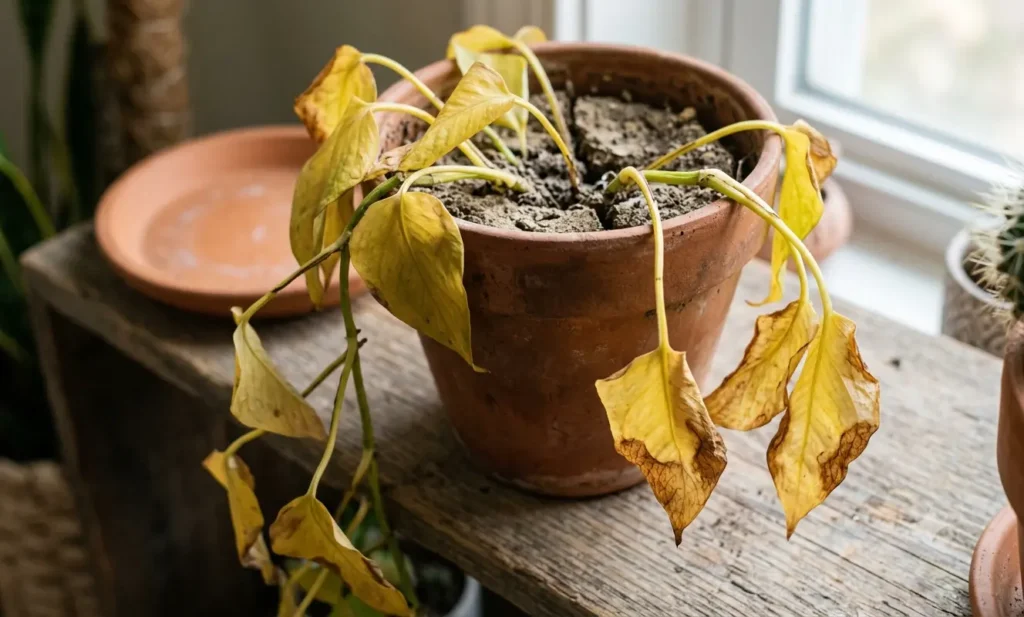
When pothos does not receive enough light, the yellow pattern is different from any watering-related cause — new leaves come in pale, washed-out yellow-green rather than a rich green, while older leaves may stay reasonably green for a time before slowly fading. The plant also produces noticeably smaller leaves, and the internodal spacing (distance between leaves on the vine) increases as the plant stretches toward any available light source. If the most recently produced leaves are paler than the ones that came before them, insufficient light is almost certainly the cause.
Fix: Move the plant progressively closer to a window with indirect light. Do not move it from deep shade to direct bright sun in a single step the sudden change stresses already-weakened foliage. Shift it one position closer to the window every 3 to 4 days over two weeks. For severely dark rooms, a full-spectrum grow light running 10 to 12 hours daily solves the problem completely without any window access needed.
Cause 4: Natural Aging (This Is Normal – Do Nothing)
Pothos leaves turning yellow on the oldest, lowest sections of the vine one or two at a time, while the rest of the plant looks healthy and continues producing green growth is not a problem. It is normal leaf aging. Pothos, like every other plant, cycles through leaf production. As the plant produces new growth, the oldest leaves at the base of the vine are progressively shed. A healthy, actively growing pothos may drop one or two lower leaves per month during the growing season with no care intervention needed. This yellowing is different from problem yellowing because it is isolated to the oldest growth, moves slowly, and the plant otherwise shows no signs of distress.
Fix: None required. Remove the yellow leaf cleanly at the stem base and continue your regular care routine.
Cause 5: Nutrient Deficiency
Pothos in depleted soil or pothos that has not been repotted or fertilized in over 18 months can develop nutrient-related yellowing with a specific visual pattern depending on which nutrient is deficient. Nitrogen deficiency produces uniform pale yellowing across older leaves as the plant scavenges nitrogen from lower foliage to support new growth. Iron or magnesium deficiency produces interveinal chlorosis yellow leaf tissue between still-green veins typically appearing on newer growth first. Potassium deficiency shows as yellowing and browning at leaf edges on older leaves.
Fix: For general nutrient depletion, apply a balanced liquid fertilizer at half strength once every 4 weeks during spring and summer. Jack’s Classic All Purpose 20-20-20 is reliable for pothos and corrects nitrogen-related yellowing within two to three new leaf cycles. For suspected iron or magnesium deficiency, a fertilizer containing micronutrients or a separate Epsom salt solution (1 teaspoon per liter of water, applied once monthly) addresses the specific deficiency. Our guide on best fertilizer for houseplants covers which formula to choose based on the deficiency pattern you are seeing. Always verify overwatering is not the underlying cause before applying any fertilizer. Fertilizer on a plant with damaged roots makes the situation worse.
Cause 6: Root Rot
Root rot produces the most alarming version of pothos leaves turning yellow because the yellowing spreads rapidly and does not respond to any surface-level fix. The diagnostic signature: the plant wilts and yellows despite the soil feeling moist or wet, multiple leaves yellow simultaneously rather than progressively, and if you remove the plant from its pot, the roots are dark brown to black, soft, and may smell sour. Root rot occurs when pothos roots sit in waterlogged soil long enough that anaerobic bacteria begin decomposing root tissue. By the time yellowing appears, root damage is already significant.
Fix: Remove the plant from its pot immediately. Cut away all dark, soft, or mushy roots using clean scissors or pruning shears sterilized in rubbing alcohol. Leave only firm, light-colored roots. Let the trimmed root system air-dry for 30 to 60 minutes. Repot into fresh, well-draining potting mix in a pot with drainage holes do not reuse the old soil or the old pot without thorough cleaning. Hold off on watering for 5 to 7 days after repotting to allow cut root ends to callus and reduce the risk of reinfection. Our detailed guide on root rot treatment covers the complete rescue process with photos of what healthy versus rotted roots look like.
Cause 7: Pest Damage
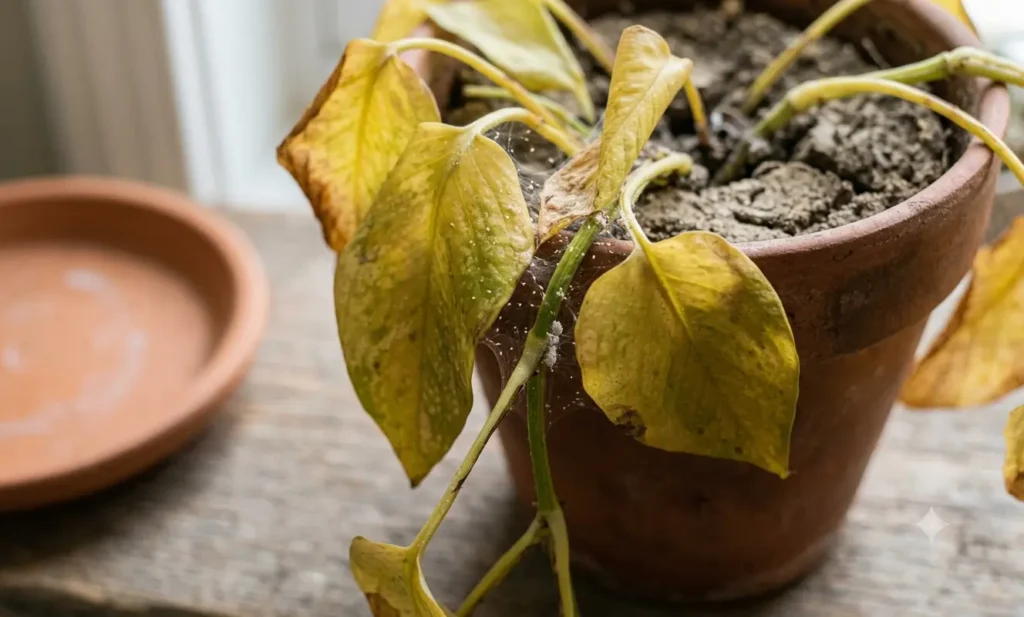
Pothos leaves turning yellow from pest damage has a distinct texture-based clue that separates it from every other cause: the yellowing is accompanied by visible stippling, pale spotting, fine webbing, or sticky residue on the leaf surface and undersides. Spider mites cause tiny pale speckles across the leaf surface and fine webbing at stem junctions. Mealybugs produce cottony white clusters and a sticky film. Aphids cluster on new growth and leave sticky honeydew. In all cases, the yellow patches develop in irregular spots rather than the uniform or progressive patterns of water or nutrient problems.
Fix: Isolate the affected plant from others immediately to prevent spread. Rinse the plant thoroughly in the sink or shower to physically remove as many pests as possible. Then apply a neem oil spray to all leaf surfaces, including the undersides, at standard concentration. Repeat every 7 days for 3 to 4 treatments to break the pest lifecycle. Our complete guide on neem oil for plants covers the correct mixing ratio, application timing, and frequency schedule for treating all common houseplant pests.
Cause 8: Over-Fertilizing
Over-fertilizing causes a specific yellowing pattern that starts with brown, crispy leaf tips — from fertilizer salt burn at the leaf margins which then progresses to yellow discoloration spreading from the tips toward the leaf base. You may also see a white, crusty residue forming on the soil surface from accumulated mineral salts. This cause is most common after applying fertilizer at full label strength rather than the half-strength that indoor houseplants require, or after fertilizing through winter when the plant is not actively growing and cannot absorb the nutrients.
Fix: Flush the soil thoroughly by running water through the pot at the sink for a full 2 to 3 minutes until it runs completely clear from the drainage hole. This removes accumulated fertilizer salt from the root zone. Allow the soil to dry normally before resuming watering. Do not fertilize again until the following spring if this occurred in fall or winter, or wait 4 to 6 weeks if it occurred during the growing season before resuming at half-strength concentration only.
Preventing Pothos Leaves from Turning Yellow
Most cases of pothos leaves turning yellow are preventable with three consistent habits:
- Check before watering. Every time, without exception. Push a finger 2 inches (5 cm) into the soil. If it is still moist, close the watering can and walk away. This single habit eliminates overwatering the most common cause of yellow leaves entirely.
- Match your light to your variety. Solid green pothos varieties like Jade handle low light well and will not yellow from insufficient light in most normal rooms. Variegated types like Marble Queen and Pearls and Jade need consistently more light to stay green. If your variegated pothos keeps producing pale, yellowish leaves, the fix is more light, not more fertilizer.
- Fertilize only during the growing season at half strength. Pothos does not need heavy feeding. A balanced liquid fertilizer at half the label strength, applied monthly from March through August, covers nutritional needs without the salt buildup that causes burn and yellowing. Skip all fertilizing from September through February.
For the complete seasonal care routine that keeps pothos healthy and minimizes the conditions that cause yellow leaves in the first place, our full pothos plant care guide covers light, watering, fertilizing, and pruning in detail across every season.
FAQ
Why are my pothos leaves turning yellow after repotting?
Some yellowing after repotting is normal. When roots are disturbed during repotting, the plant temporarily loses some of its ability to absorb water and nutrients, and one to three lower leaves may yellow and drop in the first two weeks. This is not a sign that something went wrong. Keep the plant in stable conditions consistent indirect light, no fertilizing for 4 to 6 weeks, and watering only when the top inch of soil is dry and new growth will resume normally once the root system re-establishes in the new soil.
Can yellow pothos leaves turn green again?
No. Once a pothos leaf loses its chlorophyll and turns yellow, the pigment does not return to that specific leaf. Fixing the underlying cause stops new yellowing from occurring and allows the plant to produce healthy green leaves going forward, but the leaves that have already turned yellow will not recover their color. Remove fully yellow leaves cleanly at the stem base and focus on the health of the new growth rather than trying to restore damaged foliage.
Why are my pothos leaves turning yellow in winter?
Winter yellowing is usually caused by one of two things: overwatering at the same frequency as summer (the plant’s growth has slowed and it needs far less water in winter), or reduced light as days shorten and sun angles change. Both causes are correctable. Extend the time between waterings by 30 to 50 percent in winter, and if the plant is more than 6 feet (180 cm) from a window, move it closer to compensate for the reduced light intensity during shorter days.
How many yellow leaves is too many?
One or two lower yellow leaves per month on an otherwise healthy pothos is within the normal range of aging. If three or more leaves are yellowing simultaneously, or if the yellowing is progressing from lower leaves to mid-plant leaves within a single week, that indicates an active problem requiring diagnosis and intervention rather than normal aging.
My pothos is in a dark corner and the leaves are turning yellow. What should I do?
Move it to better light immediately. Pothos tolerates low light better than most houseplants, but it does not thrive in genuine darkness. A room that feels dim to human eyes receives roughly 50 to 100 foot-candles of light — insufficient for pothos to maintain healthy leaf color over time. Move the plant to within 4 to 6 feet (120 to 180 cm) of any window, or add a grow light. Yellowing from insufficient light is not reversible on affected leaves, but new growth will come in green once light conditions improve.
Pothos leaves turning yellow almost always comes down to one of these eight causes, and most of them point back to watering either too much or too little. When in doubt, check the soil before anything else. The soil condition at root depth answers more diagnostic questions than any visual inspection of the leaves alone. Fix the root cause, remove the yellow leaves, and the plant does the rest.
Happy planting!