
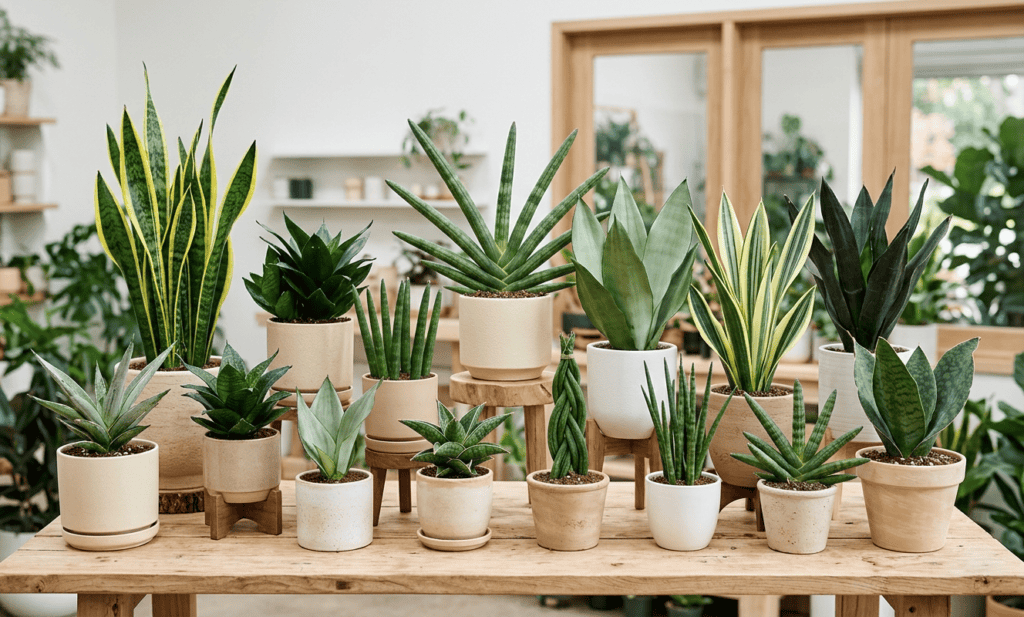
Picture standing in front of the snake plant section at a well-stocked nursery. There are tall, upright swords with yellow edges. Short rosettes that barely reach 8 inches. Round tubular stalks fanning out from the base. A single giant paddle-shaped leaf standing alone in a 10-inch pot. All of them snake plants. All of them sharing the same no-fuss care needs. But each one looking completely different from the next, suited to a different space, a different aesthetic, and a different kind of plant parent.
Understanding snake plant varieties is one of the most practical things you can do before buying, because the wrong variety for a small apartment shelf or a dim office corner is going to disappoint in ways the right variety never would. This guide covers 13 snake plant varieties in detail, including what makes each one visually distinctive, what it needs, and exactly who should be growing it.
| Aspect | Details |
|---|---|
| Botanical Name (Current) | Dracaena trifasciata (and related species) |
| Former Name (Still Widely Used) | Sansevieria trifasciata |
| Name Change Year | 2017 (reclassified from Sansevieria to Dracaena) |
| Plant Family | Asparagaceae |
| Native Region | Tropical West Africa (Nigeria to Congo) and parts of Asia |
| Common Names | Snake plant, mother-in-law’s tongue, viper’s bowstring hemp, Saint George’s sword |
| Number of Known Varieties | 70+ species formerly in Sansevieria genus |
| Light Range (All Varieties) | Low indirect to bright indirect light |
| Toxicity | Toxic to cats, dogs, and horses (ASPCA) |
| Difficulty | Beginner |
| USDA Zones | 9-12 outdoors; houseplant everywhere else |
Why Snake Plant Varieties Look So Different From Each Other
The diversity you see across snake plant varieties exists because the plants that were formerly grouped under the genus Sansevieria and reclassified as Dracaena in 2017 span dozens of species native to different parts of Africa and Southeast Asia. Each species evolved in different growing conditions, producing radically different leaf shapes, sizes, and growth habits. Some grew upright in grasslands and developed tall, stiff sword-like leaves. Others grew in rocky, shaded environments and developed compact rosette forms that stay low to the ground. Still others developed cylindrical, tubular leaves that reduce surface area to minimize water loss in arid conditions.
The result is a group of plants that share the same remarkable drought tolerance and low-light adaptability but present completely different visual profiles. What connects all snake plant varieties is the underlying physiology: thick leaves that store water, CAM photosynthesis that allows them to take in CO2 at night, and a root system that is extremely sensitive to overwatering. These traits are consistent across all snake plant varieties regardless of how different they look on the outside.
The 13 Snake Plant Varieties Worth Knowing
1. Golden Snake Plant – Dracaena trifasciata ‘Laurentii’
The Golden Snake Plant is the variety most people picture when they hear “snake plant,” and it is almost certainly the one sold at Home Depot, Lowe’s, and Trader Joe’s when you see generic “snake plant” signage. Tall, upright sword-shaped leaves grow to 3 to 4 feet (90 to 120 cm) in a good light position, with dark green horizontal banding across the leaf surface and a distinctive bright yellow margin running along both edges of each leaf. This yellow margin is the ‘Laurentii’ cultivar’s defining feature and the reason it outsells every other snake plant variety by a significant margin in US garden centers.
The Laurentii needs a little more light than all-green snake plant varieties to maintain that yellow margin saturation. In low light, the yellow fades toward pale green and the overall color contrast becomes less striking. Best for: Anyone who wants the classic tall, architectural snake plant look and has a spot with at least medium indirect light. Read our complete snake plant care guide for the full light, watering, and fertilizing routine that applies to this variety.
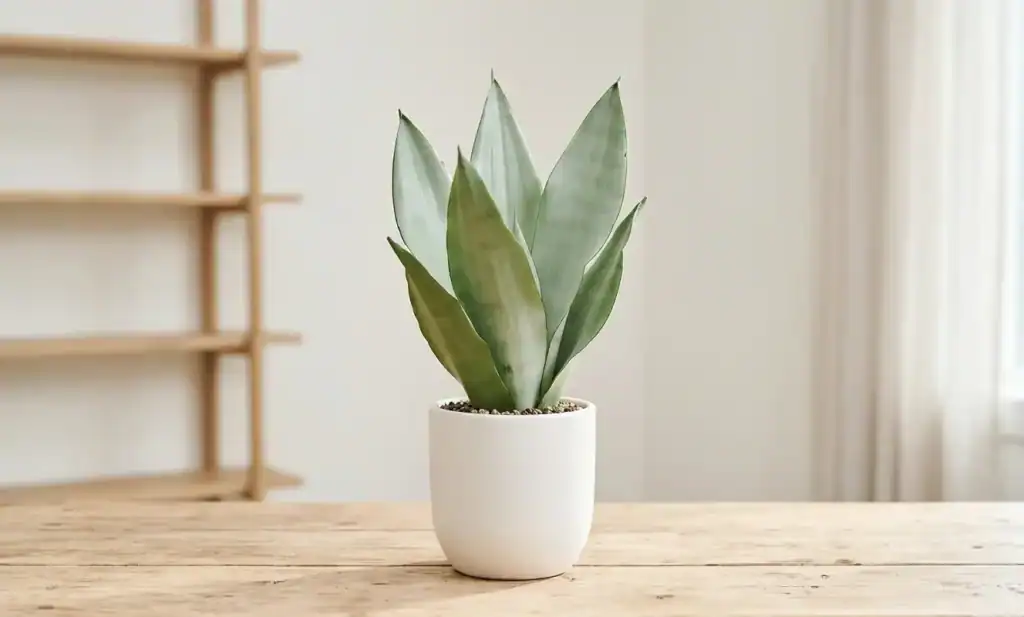
2. Moonshine Snake Plant – Dracaena trifasciata ‘Moonshine’
Moonshine is one of the most distinctive of all snake plant varieties in terms of color, producing broad, upright leaves in a silvery, pale mint-green rather than the dark green most people associate with the plant. The leaves can reach 2 to 3 feet (60 to 90 cm) tall and grow wider than the standard trifasciata, with faint darker banding visible when the plant is in good light. In low light conditions, the pale silvery tone darkens toward a more standard green, which is one reason experienced collectors always grow Moonshine in medium to bright indirect light.
The effect in a bright room is genuinely unusual it photographs almost gray-silver in natural light, and it draws attention in a way that green snake plant varieties rarely do. Moonshine also grows more slowly than Golden or Jade snake plant varieties, which means it works well in smaller spaces where a faster-growing variety would outgrow the available spot within a season or two. Best for: Minimalist interiors, gray or white design schemes, collectors who want a visually unusual variety.
3. Bird’s Nest Snake Plant – Dracaena trifasciata ‘Hahnii’
Bird’s Nest is the compact dwarf of the snake plant varieties group, forming a low, open rosette of short, broad leaves that grows to only 6 to 8 inches (15 to 20 cm) tall rather than the 3 to 4 feet of most other varieties. The leaves are shorter and wider than standard trifasciata, arranged in a dense spiral that does genuinely resemble a bird’s nest when viewed from above. This compact growth habit makes Bird’s Nest the best snake plant variety for shelf displays, small windowsills, desk plants, and any situation where horizontal space is available but vertical height would create a problem. Bird’s Nest grows slowly and produces offsets from the base over time that can be separated and repotted to create new plants.
It tolerates the same range of low-light conditions as larger snake plant varieties, making it one of the most versatile options across different indoor environments. Best for: Small spaces, office desks, shelves, beginner collectors. If you want to build a grouping of low-maintenance plants that include Bird’s Nest, our guide on easiest indoor plants covers the best companion options for shelf arrangements.
4. Cylindrical Snake Plant (African Spear) – Dracaena angolensis
The Cylindrical Snake Plant is one of the most structurally unusual snake plant varieties, producing perfectly round tubular leaves rather than the flat sword-shapes of most other types. Each leaf is rigid, pointed at the tip, and grows to 3 to 4 feet (90 to 120 cm) tall in a mature plant, with a dark green color and faint horizontal banding. The leaves emerge from the base in a fan arrangement that, depending on how the nursery has trained the plant, can look formal and architectural or wild and sculptural. Braided versions of this variety where young leaves are woven together as they grow are commonly sold at specialty stores and online, though the braiding is a cosmetic technique added by the grower rather than a natural feature.
Cylindrical snake plant varieties need the same basic care as flat-leaved types but are particularly sensitive to overwatering because the tubular leaf structure means they store water even more efficiently than flat-leaved varieties. Best for: Modern and minimalist interiors, plant collectors who want something genuinely unusual.
5. Starfish Snake Plant – Dracaena angolensis (Fan Form)
The Starfish Snake Plant is a compact fan-shaped form of the same cylindrical species above, where the tubular leaves spread outward horizontally from the base rather than growing upright. The result is a plant that typically stays under 10 inches (25 cm) tall while spreading 10 to 12 inches (25 to 30 cm) wide in a circular, starfish-like arrangement. The leaves are the same cylindrical, pointed-tip structure as the standard Cylindrical variety, banded with horizontal markings in gray-green and dark green.
Starfish is one of the rarer snake plant varieties at general garden centers but is available through specialty online nurseries and periodically at Trader Joe’s. It is an excellent conversation-starter plant for a bright windowsill and stays compact enough for a desk or small shelf without regular pruning. Best for: Collectors, small bright windowsills, anyone who wants a dramatically different form factor from the standard upright snake plant look.
6. Whale Fin Snake Plant – Dracaena masoniana
The Whale Fin is one of the most dramatic statement plants in the entire snake plant varieties group, producing a single large, paddle-shaped leaf per growth point rather than a cluster of multiple upright leaves. Each leaf can reach 4 feet (120 cm) tall and 10 inches (25 cm) wide, giving the plant the appearance of a giant fin rising from the soil. The leaf surface is dark mottled green with subtle horizontal banding, and the single-leaf-per-offset growth habit means the plant grows very slowly and each leaf is an event rather than one among many.
Whale Fin is consistently one of the more expensive snake plant varieties at specialty nurseries, partly because of its slow growth and partly because of its dramatic appearance. It prefers medium to bright indirect light and is more sensitive to cold than most trifasciata varieties. Best for: Statement corners, plant collectors, minimalist spaces where one dramatic plant is more impactful than a grouping of smaller plants.
7. Bantel’s Sensation – Dracaena trifasciata ‘Bantel’s Sensation’
Bantel’s Sensation is one of the rarest of the named snake plant varieties in regular retail circulation, producing narrow, upright leaves with striking white vertical striping that runs lengthwise rather than the horizontal banding found on most other types. The white portions of the leaf can account for up to 30 to 40 percent of the leaf surface on a well-lit plant, creating a bright, high-contrast appearance that stands out clearly from all other snake plant varieties.
Narrow leaves reach 2 to 3 feet (60 to 90 cm) tall and are significantly thinner than standard trifasciata leaves, which makes the plant look almost grass-like in its profile. The high white variegation content means Bantel’s Sensation needs more light than plain green snake plant varieties in low light, the white portions reduce and the overall plant becomes less visually interesting. Best for: Collectors, bright rooms, anyone who wants vertical drama without the wide footprint of Laurentii or Whale Fin.
8. Twisted Sister – Dracaena trifasciata ‘Hahnii Twisted Sister’
Twisted Sister is a compact rosette form, like Bird’s Nest, but with an additional visual feature: the leaves twist and curl as they grow, creating a spiraling, almost sculptural arrangement that is different from any other snake plant variety in common circulation. The leaves have yellow margins similar to Laurentii but stay short, reaching 8 to 12 inches (20 to 30 cm) tall in a dense, twisted cluster. Growth is slow and the plant stays compact enough for a small pot for several years, making it an excellent choice for people who want something visually interesting without committing to a large plant or frequent repotting.
Twisted Sister needs the same medium-to-bright indirect light as other variegated snake plant varieties to maintain its yellow margin color. Best for: Shelf displays, collector groupings, anyone who wants a compact snake plant variety with visual texture.
9. Futura Superba – Dracaena trifasciata ‘Futura Superba’
Futura Superba is a medium-height snake plant variety that combines the yellow margins of the Laurentii with a shorter, wider leaf format. Plants typically reach 18 to 24 inches (45 to 60 cm) rather than the full 4 feet of a mature Laurentii, making it a good intermediate option for people who want the classic yellow-edged look but in a more compact package.
The leaves are broader than standard trifasciata and have a slightly softer blue-green base color beneath the dark horizontal banding and yellow margins. Growth rate is moderate and the plant is widely available at US garden centers under the Futura Superba name. Best for: Bedroom plants, medium shelf positions, anyone who wants the classic Laurentii look in a height that fits smaller spaces.
10. Futura Robusta – Dracaena trifasciata ‘Futura Robusta’
Futura Robusta is the all-green counterpart to Futura Superba, sharing the same medium-height, wide-leaf format but without the yellow margins. The leaves are a rich blue-green with silver-green horizontal banding, and the overall impression is bolder and more solid than the more common striped snake plant varieties. Without any variegation, Futura Robusta tolerates lower light conditions better than yellow-margined varieties and is a good choice for rooms that do not receive consistent bright indirect light. Best for: Lower-light rooms, minimalist interiors that suit deep solid-green foliage, anyone who finds the yellow-edged varieties too visually busy.
11. Black Gold – Dracaena trifasciata ‘Black Gold’
Black Gold is one of the most dramatic of the tall snake plant varieties, producing very dark, almost black-green leaves with the bright yellow margins of the Laurentii. The contrast between the near-black leaf surface and the yellow edge is more striking than on standard Laurentii, which has a lighter base green. Plants reach 3 to 4 feet (90 to 120 cm) and the dark coloration becomes more intense in higher light conditions. Black Gold is not as commonly available at general garden centers as Laurentii but appears regularly at specialty plant shops and online nurseries. Best for: Dramatic, high-contrast interiors, anyone who grows multiple snake plant varieties and wants maximum visual distinction between them.
12. Cleopatra – Dracaena trifasciata ‘Cleopatra’
Cleopatra is a rosette-form snake plant variety with an unusually intricate leaf pattern each leaf features multiple shades of green in horizontal bands with a decorative precision that makes it look almost engineered. The rosette stays compact, reaching 6 to 10 inches (15 to 25 cm) tall with leaves that are slightly wavy at the margins, adding a texture that most flat-leaved snake plant varieties lack. Cleopatra is considered a specialty variety and is harder to find than the mainstream types, but it is available through specialty online retailers and plant subscription boxes. Best for: Plant collectors, coffee tables, decorative displays where detail in the leaf surface matters.
13. Fernwood Mikado – Dracaena parva hybrid
Fernwood Mikado is a hybrid snake plant variety with dark green, slightly marbled cylindrical leaves that emerge from the base in a dense, upright fan arrangement. The leaves are narrower than most trifasciata varieties and grow in clusters of 10 to 20 thin, pointed stems per pot, creating a grass-like density that is quite different from any of the flat-leaved types. Height stays moderate at 18 to 24 inches (45 to 60 cm) and the overall effect is bushy and full in a way that most snake plant varieties are not. Fernwood Mikado is available at specialty nurseries and handles lower light slightly better than the cylindrical Dracaena angolensis. Best for: Textural interest, collectors who want cylindrical leaf structure in a denser, more accessible format.
Snake Plant Varieties Comparison Table
| Variety | Height | Leaf Shape | Distinguishing Feature | Light Need | Best For |
|---|---|---|---|---|---|
| Laurentii (Golden) | 3-4 ft (90-120 cm) | Flat sword | Bright yellow margins | Medium-Bright | Classic look, most available |
| Moonshine | 2-3 ft (60-90 cm) | Flat sword, wide | Silvery-pale green color | Medium-Bright | Minimalist, unusual color |
| Bird’s Nest ‘Hahnii’ | 6-8 in (15-20 cm) | Short rosette | Compact, stays tiny | Low-Bright | Small spaces, shelves |
| Cylindrical/African Spear | 3-4 ft (90-120 cm) | Round tube | Perfectly round leaves | Medium-Bright | Modern, architectural |
| Starfish | 8-10 in (20-25 cm) | Round tube, fan | Horizontal fan arrangement | Medium-Bright | Collectors, small spaces |
| Whale Fin | 3-4 ft (90-120 cm) | Single paddle | One massive leaf per plant | Medium-Bright | Statement plants |
| Bantel’s Sensation | 2-3 ft (60-90 cm) | Narrow flat | White vertical stripes | Bright | Collectors, bright rooms |
| Twisted Sister | 8-12 in (20-30 cm) | Twisted rosette | Curled, yellow-edged rosette | Medium-Bright | Shelf displays |
| Futura Superba | 18-24 in (45-60 cm) | Wide flat | Yellow margins, medium height | Medium-Bright | Medium spaces |
| Futura Robusta | 18-24 in (45-60 cm) | Wide flat | Dark blue-green, no yellow | Low-Bright | Low-light rooms |
| Black Gold | 3-4 ft (90-120 cm) | Flat sword | Near-black leaves, yellow edge | Medium-Bright | High-contrast spaces |
| Cleopatra | 6-10 in (15-25 cm) | Short rosette | Intricate banded patterns | Medium-Bright | Detail-focused display |
| Fernwood Mikado | 18-24 in (45-60 cm) | Thin cylindrical | Dense grassy clusters | Low-Medium | Texture, density |
How to Choose the Right Snake Plant Variety for Your Space
Most people choose snake plant varieties based on appearance alone and end up with something that does not suit the practical realities of where they plan to keep it. A better approach is to filter by three things before aesthetics: height, light, and your growing track record.
- Filter by height first. If you have a shelf or desk, Bird’s Nest, Twisted Sister, Cleopatra, or Starfish will stay appropriately sized for years without outgrowing the space. If you want a floor plant or a tall architectural element, Laurentii, Moonshine, Black Gold, or Whale Fin is the right category. Medium options like Futura Superba fill the space between those two extremes.
- Filter by light next. If your best available spot receives less than 4 hours of indirect light daily, choose solid-green or minimally variegated snake plant varieties: Futura Robusta, Jade Snake Plant, or Fernwood Mikado. Heavily variegated types like Bantel’s Sensation and Moonshine need more light to maintain their color intensity and look their best. Our guide on low light indoor plants covers how to assess the actual light level in different rooms before buying any plant.
- Then choose by aesthetics. Within the options that fit your height and light criteria, pick what genuinely appeals to you. Snake plant varieties are long-lived plants – a well-cared-for specimen can outlast most furniture in the same room, so buying something you find visually boring because it seemed practical is a trade-off that compounds over years. For the right container to complement whichever variety you choose, our guide on best planters for indoor plants covers sizing, material, and drainage options for snake plants specifically.
Care Basics That Apply to All Snake Plant Varieties
Regardless of which snake plant varieties you grow, the fundamental care rules are identical because the underlying physiology is the same across all members of the former Sansevieria group.
- Watering is the most critical. All snake plant varieties store water in their thick leaves and roots, which means they need far less water than most people give them. Water only when the soil is completely dry at root depth, which typically means every 14 to 21 days in summer and every 21 to 35 days in winter. Overwatering is the most common cause of decline across all snake plant varieties. For a detailed seasonal watering schedule and how to check soil moisture correctly, our guide on snake plant watering covers the complete routine. If you have already overwatered and suspect root rot, our guide on root rot treatment covers the diagnosis and recovery process step by step.
- Soil and drainage must support rapid drying between waterings. A standard potting mix amended with 30 to 40 percent perlite, or a cactus and succulent mix, drains quickly enough to prevent the soggy soil conditions that damage roots. Every snake plant variety must be in a pot with drainage holes.
- Toxicity is consistent across all snake plant varieties. According to the ASPCA, all Dracaena trifasciata varieties and related species are toxic to cats, dogs, and horses, causing vomiting, drooling, and diarrhea if ingested. If you have pets, our guide on snake plant toxicity to cats covers exactly what happens after ingestion and how to keep pets safe. For non-toxic alternatives, our guide on indoor plants safe for cats lists 15 confirmed pet-safe options.
- Propagation works the same way across most snake plant varieties: leaf cuttings placed in water or well-draining soil root within 4 to 8 weeks. Division of established pups at the base is the faster and more reliable method for maintaining the exact characteristics of variegated varieties, because leaf cuttings from variegated types like Laurentii sometimes revert to all-green growth. Our complete guide on how to propagate snake plant covers both methods with timing and step-by-step instructions.
Rare and Collector Snake Plant Varieties to Watch For
Beyond the 13 varieties covered above, the former Sansevieria genus contains dozens of less common species that appear occasionally at specialty nurseries and plant expos. Dracaena trifasciata ‘Whitney’ produces gray-green leaves with darker edges rather than yellow, sitting in a different color palette from most named varieties. Dracaena hanningtonii produces very tall, dark green cylindrical leaves that exceed 6 feet (180 cm) in the right conditions, making it one of the largest snake plant varieties available.
Dracaena pinguicula is a rare, slow-growing desert species with thick, succulent, upward-curving leaves that looks more like an agave than any of the common snake plant varieties. These collector-level plants rarely appear at general garden centers but come through specialty online retailers and plant society sales several times a year.
Mistakes When Buying Snake Plant Varieties
- Buying Bantel’s Sensation or Moonshine for a dark room. Both of these varieties need consistently good light to maintain their distinctive appearance. In dim conditions, both revert toward a flatter, less interesting green that makes them look like inferior versions of the cheaper, more common varieties.
- Assuming all snake plant varieties grow at the same speed. Whale Fin, Cleopatra, Twisted Sister, and Bantel’s Sensation grow significantly more slowly than Golden Laurentii or Jade. If you want visible new growth within the first season, choose a fast-growing variety like Laurentii or Robusta rather than a slow collector variety.
- Putting any snake plant variety in a pot without drainage. This applies to every snake plant variety without exception. Decorative cachepots used as sleeves around a nursery pot are fine. Decorative pots used as the actual growing container without drainage holes will cause root rot within a few watering cycles regardless of how carefully you water.
- Buying based only on height at purchase. A 6-inch Bird’s Nest stays 6 to 8 inches permanently. A 6-inch Golden Laurentii will reach 3 to 4 feet in 2 to 3 years under good conditions. Both could be in the same section of a nursery at the same price. Knowing the mature size of snake plant varieties before buying prevents a lot of surprises.
FAQ
What are the most popular snake plant varieties for beginners?
The most beginner-friendly snake plant varieties are Golden Laurentii (tall, the most commonly available), Bird’s Nest Hahnii (compact, perfect for small spaces), and Futura Robusta (medium height, handles low light well). All three tolerate the same range of neglect that makes snake plants famous for resilience. Our detailed snake plant care guide covers the full care routine that applies to all three.
What is the rarest snake plant variety?
Among commercially available snake plant varieties, Bantel’s Sensation is one of the harder to find at general garden centers due to its slow growth and limited production. Whale Fin (Dracaena masoniana) is also rare relative to its popularity and commands significantly higher prices than common varieties. Among true collector plants, Dracaena pinguicula and Dracaena hanningtonii are rarely seen outside specialty sales.
Do all snake plant varieties need the same care?
The fundamental care requirements infrequent watering, well-draining soil, no waterlogging are the same across all snake plant varieties. The main difference is light. Variegated snake plant varieties like Moonshine, Laurentii, and Bantel’s Sensation need more light to maintain their color intensity than all-green or minimally-variegated varieties like Futura Robusta or Jade.
Which snake plant variety is best for low light?
For the lowest light conditions, the best snake plant varieties are Futura Robusta, Jade Snake Plant, and Fernwood Mikado. All three maintain acceptable growth and appearance in rooms with limited natural light. Avoid Bantel’s Sensation, Moonshine, and Starfish in truly dim conditions, as their distinctive features fade significantly without adequate light.
How many snake plant varieties are there?
The former Sansevieria genus, now reclassified as Dracaena, contained approximately 70 recognized species before the taxonomic change. With named cultivars, hybrids, and horticultural varieties included, the total number of distinct snake plant varieties available to collectors exceeds 200. The 13 varieties covered in this guide represent the most widely available and visually distinct options in the US market.
Can different snake plant varieties be planted together in one pot?
Yes, and this is a popular technique for creating visually interesting arrangements. Bird’s Nest and Twisted Sister are often combined with each other or with compact succulents. Taller varieties like Laurentii and Black Gold can be combined in a large statement pot where their different margin colors provide contrast. The care requirements are identical across snake plant varieties, so they coexist without competing, as long as the pot is large enough to give each plant adequate root space.
Are all snake plant varieties toxic to cats?
Yes. According to the ASPCA, all common snake plant varieties are toxic to cats, dogs, and horses. The toxic compounds are saponins present in the leaves of all Dracaena trifasciata varieties and related species. There is no non-toxic snake plant variety. If you have cats that chew on plants, snake plant varieties of any kind should be placed well out of reach.
All 13 snake plant varieties covered in this guide share the same foundational qualities that make the snake plant one of the most recommended houseplants in the world: minimal watering, wide light tolerance, drought resilience, and a root system that is practically indestructible when treated correctly. The variation between types gives you genuine choices about size, color, texture, and form factor that most plant genera simply do not offer. Whether you want a 4-foot architectural statement or a compact 6-inch shelf plant, whether you want silver-pale foliage or near-black leaves with yellow edges, there is a snake plant variety that fits the space you have and the look you are after.
Happy planting!